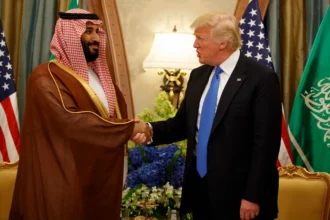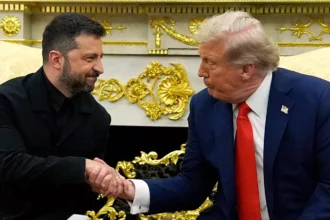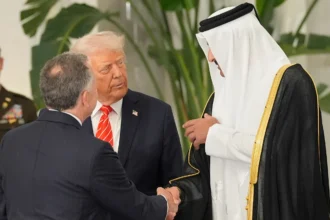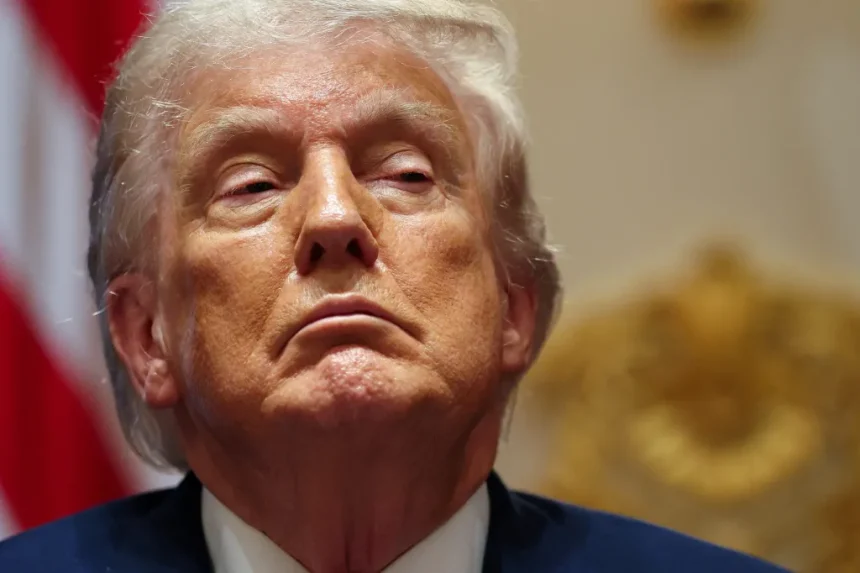
A terse exchange between President Trump and Israeli Prime Minister Benjamin Netanyahu has reportedly underscored a growing impatience within Washington regarding the ongoing conflict, a sentiment not lost on financial markets. Sources close to the discussion, as reported by Axios, indicate a heated conversation on Monday where Trump, expressing significant frustration, told Netanyahu, “You’re f—ing crazy.” This blunt assessment arrived as Wall Street analysts, particularly those monitoring energy markets, are actively forecasting a de-escalation of tensions in the Middle East, specifically regarding the Strait of Hormuz.
Deutsche Bank’s recent “World Outlook,” for instance, posits an assumption that the critical shipping lane will reopen by late June. This outlook suggests a baseline expectation among some financial institutions that a deal between the U.S. and Iran will materialize this month, allowing maritime traffic through the Strait of Hormuz to normalize. Such a development could see Brent crude prices fall to approximately $86 per barrel in the fourth quarter, a significant shift from the current volatile environment. The Greek shipping line Dynacom Tankers has already demonstrated a partial breach of blockades, with eight of its vessels having transited the Strait and another six preparing to do so, a move its founder, George Prokopiou, attributes to Greece’s historical prowess in navigating blockades.
The diplomatic landscape, however, remains complex and contradictory. While Trump publicly stated on Truth Social that both Iran and Israel had agreed to a cessation of hostilities, Netanyahu offered a different narrative. The Israeli Prime Minister maintained that strikes on Beirut would continue unless Hezbollah ceased its attacks on Israeli cities and civilians, and that Israeli forces would not withdraw from southern Lebanon. This divergence highlights a fundamental disagreement on the ground, even as Trump, according to CNBC, expressed his waning interest in the protracted peace talks, dismissing them as “very boring.” Overnight reports confirmed that Israel and Hezbollah continued to engage in active conflict, further illustrating the disconnect between political rhetoric and battlefield realities.
Beyond the immediate geopolitical concerns, broader economic shifts are prompting caution among investors. Bank of America’s Savita Subramanian points to a significant transformation within the major AI hyperscalers, noting their transition from “capital light” to “capital intensive” operations. This shift is characterized by shrinking cash flow and an increasing reliance on debt, as companies like Amazon, Google, Meta, Microsoft, and Oracle pour capital into AI infrastructure. The sector, once a robust source of cash, has become a major consumer of it, leading to a substantial increase in debt – more than triple what it was previously. This trend has not yet impacted the reported earnings of the “Magnificent Seven,” which continue to climb as a percentage of the S&P 500, but their free cash flow has notably flattened due to these substantial data center investments.
This reorientation in capital allocation, Subramanian suggests, echoes patterns seen during the late 1990s dot-com boom, where only a fraction of IPOs survived long-term, despite the enduring utility of the underlying infrastructure. The implication for investors is a need for more selective approaches to technology stocks. Meanwhile, the S&P Dow Jones is reportedly contemplating changes to its profitability rules, potentially allowing companies like SpaceX, OpenAI, and Anthropic to enter the S&P 500 with lower-quality earnings. This move could dilute index funds and ETFs, forcing ordinary investors, 401(k)s, and institutional investors to hold potentially riskier assets, a prospect Nell Minow, a corporate governance expert, described as “the opposite of what an index is supposed to be.” Adding another layer to the financial discussion, SpaceX’s S-1 IPO filing reportedly reveals holdings of 18,712 Bitcoin, significantly more than previously thought, introducing additional volatility to its balance sheet given Bitcoin’s frequent and substantial price swings.
These interwoven narratives, from the frustrations of a U.S. President with a key ally to the fundamental shifts in corporate finance and index composition, paint a picture of a global landscape undergoing rapid and often unpredictable change. Investors and policymakers alike are grappling with a complex web of geopolitical tensions, technological evolution, and market reconfigurations, all while trying to decipher the true signals amidst a cacophony of conflicting information.