
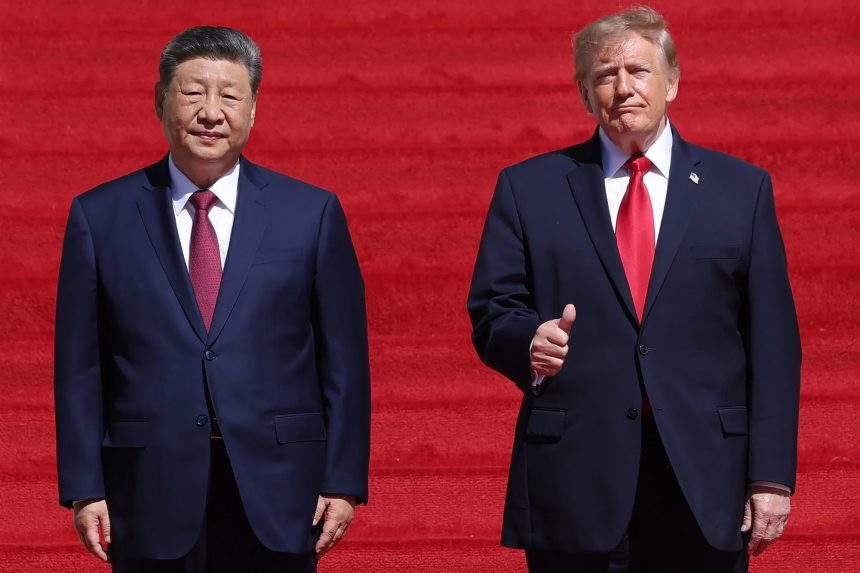
Chinese President Xi Jinping will sit down this week with Donald Trump and Vladimir Putin in a meeting that brings together the leaders of the world’s largest nuclear powers. On paper, both Russia and the United States retain far more warheads than China. Yet Xi is likely to arrive as the most powerful leader in the room, because his two counterparts are entering the summit weakened at home.
The gathering, scheduled for Thursday, comes at a moment when Beijing’s leverage over Moscow has grown dramatically. China now accounts for roughly half of Russia’s imports, nearly double the share before Putin’s invasion of Ukraine. That dependence has turned Beijing into an economic lifeline for a Kremlin isolated by sanctions and struggling to finance its war machine.
Trump’s domestic troubles
Donald Trump is facing a difficult stretch in Washington. Republicans suffered crippling defeats in the recent midterm elections, eroding his party’s position in Congress and emboldening Democrats ahead of the next presidential contest. At the same time, the scandal that removed Jensen Huang as chief executive of Nvidia has shaken one of the pillars of Trump’s technology and economic agenda, leaving the administration on the defensive about its ties to the artificial intelligence industry.
The election results also reflected public anger over the war with Iran and the higher fuel costs that followed. Trump campaigned in part on an America First platform that promised to avoid foreign entanglements, yet the conflict has dragged on and pushed gasoline prices higher. With voters frustrated, the president may be looking abroad for a victory he cannot easily find at home.
Putin’s parallel constraints
Vladimir Putin’s problems are different but no less constraining. More than four years after the invasion of Ukraine, Russia’s economy is showing the strain of sustained military spending, manpower shortages and Western sanctions. The Kremlin has become increasingly reliant on Chinese technology, machinery and consumer goods to keep its domestic market functioning.
Putin’s dependence on Beijing gives Xi significant room to shape the agenda. Whether the topic is energy deals, military cooperation or diplomatic positioning on Ukraine, Russia needs China more than China needs Russia. That imbalance is exactly what Xi appears ready to exploit.
Why Xi holds the cards
China’s strategic position has improved in part because the United States and Russia have spent years weakening each other. Washington’s support for Ukraine has drained Russian resources, while Moscow’s defiance of the Western led order has forced the US to keep large amounts of attention and military capacity tied to Europe.
Meanwhile, Beijing has deepened ties with the Global South, expanded its navy and positioned itself as the leading alternative to American economic leadership. Xi does not need a dramatic breakthrough at the summit to come out ahead. He simply needs to avoid a US Russia rapprochement that could turn Chinese interests into a common target.
What Trump wants from the meeting
For Trump, the summit offers a chance to project strength despite his domestic setbacks. He has long prided himself on dealmaking with strongmen and may see a high profile meeting with Xi and Putin as a way to change the political narrative at home. A visible role in managing the Russia Ukraine war, or in stabilising energy markets, could help him recover some of the authority he lost in the midterms.
But any agreement that looks too favourable to Putin risks alienating European allies and parts of Trump's own foreign policy team. And any concession to Xi on trade or Taiwan could invite fierce criticism from both parties in Congress. The president is walking a narrow path.
The risks of a three way dynamic
Three leader summits are rare for a reason. They create complicated optics and unpredictable bargaining dynamics. Xi can play the swing role, allowing him to extract concessions from both Trump and Putin while keeping the other two at odds. If Trump and Putin leave the meeting at odds, Beijing's position improves further.
The larger risk for Washington is that the summit normalises the idea of a multipolar world in which the United States must share the top table with rivals it once sought to contain. For Xi, that outcome would be a victory in itself, even if no treaty is signed.
What to watch
Observers will be looking for any joint statement on Ukraine, any energy or trade announcements between Beijing and Moscow, and any sign that Trump is prepared to offer Xi concessions on tariffs or technology restrictions. Body language and bilateral side meetings may matter as much as formal agreements.
Xi Jinping has spent years building toward a moment when China could sit at the centre of great power politics. With Trump wounded by domestic politics and Putin pinned down by war, that moment may have arrived sooner than anyone expected.