
Ukrainian President Volodymyr Zelensky has warned that restrictions on the Starshield satellite communications system are undermining his country’s ability to defend its energy infrastructure against Russian drone attacks. With winter approaching, the limitation comes at a moment when Moscow has stepped up strikes on Ukraine’s power grid, raising the prospect of renewed blackouts and civilian hardship.
Starshield, the secure satellite service operated by Elon Musk’s SpaceX, has become a critical link for Ukrainian forces. It enables commanders to maintain contact with drones, artillery teams and front-line units across a battlefield where conventional communications are frequently jammed or destroyed. Zelensky said on Sunday that Ukrainian interceptor drones are losing contact with their operators when flying faster than 161km/h along the front line and over Russian-occupied territory, leaving them unable to catch Russian Shahed drones before they reach their targets.
A technical problem or a policy choice?
Zelensky made clear that he sees the restrictions as more than a technical glitch. He said the limits appeared to have been imposed by SpaceX despite earlier assurances from US Secretary of State Marco Rubio that Starshield was more under American government control. The Ukrainian president has instructed his foreign ministry, defence ministry and presidential office to work closely with the United States and SpaceX to have the restrictions lifted.
“We are counting on these restrictions to be lifted,” Zelensky wrote on social media. “The protection of lives and Ukrainian energy infrastructure before winter depends on this. It is important to be on the right side of history. We need to help Ukraine.”
The episode highlights the extraordinary dependence of a sovereign state on a private American company during wartime. SpaceX has provided essential communications services to Ukraine since the early weeks of the Russian invasion, but the relationship has periodically been tense, with founder Elon Musk at times expressing reservations about how the technology is used.
Russian strikes on energy infrastructure
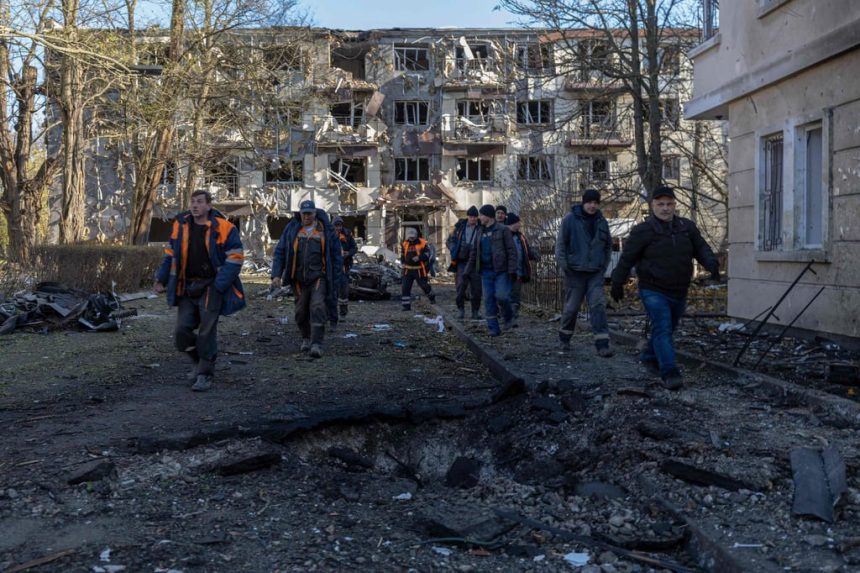
The warning came as Russian attacks on Ukrainian energy targets continued. A strike on the port city of Chornomorsk in the Odesa region injured six people and damaged energy infrastructure, according to regional head Oleh Kiper. The blast and falling debris also damaged a gas pipeline and nearby residential buildings, while two parked cars caught fire. The attack temporarily left about 41,000 customers without power after hitting a facility operated by DTEK Odesa Electric Networks.
Overnight air strikes on the southeastern city of Zaporizhzhia injured another six people, including a two-year-old boy, Ukraine’s State Emergency Service said. Zelensky said Russia had launched more than 2,300 drones, 1,590 guided aerial bombs and 15 missiles of various types against Ukraine over the past week alone.
Ukraine strikes back
Ukrainian forces have responded by targeting Russian energy and industrial sites deep inside Russia. In the Rostov region, drone strikes damaged two electrical substations and killed a chief engineer, according to Governor Yuri Slyusar. Four people were injured when debris fell on their cars, and a fifth was wounded when fragments struck a production facility in the village of Troitskoye.
Ukrainian drones also struck targets in Russia's Tatarstan region, officials said. Radmir Belyaev, mayor of Nizhnekamsk, said a large-scale and prolonged attack damaged the city's industrial zone, injuring six people and disrupting heating and hot water supplies. Ukraine's General Staff said it had hit two sites in Nizhnekamsk: Nizhnekamskneftekhim, one of the largest petrochemical complexes in Europe, and a production site operated by Sibur. An oil refinery in the area was also struck.
Russia's Defence Ministry said its forces shot down 533 Ukrainian drones overnight across 13 Russian regions, the Russian-annexed Ukrainian peninsula of Crimea, and the Black and Azov seas.
Black Sea maritime tensions
The conflict is also spilling into the maritime domain. Romanian Prime Minister Luca Niculescu said three commercial vessels in the Black Sea were struck by drones overnight, the latest in a string of attacks that have raised fears of the war expanding into Nato territory.
"Once again, maritime security in the Black Sea has been threatened," Niculescu wrote on social media. Romania's Ministry of National Defence said a Greek-flagged oil tanker was hit by a drone, sparking a fire that was extinguished by the crew. Two more ships were later struck, and their crews also put out fires on board. No casualties were reported and the ministry did not identify the origin of the drones.
"These incidents are unacceptable and constitute a violation of international law," Niculescu said, adding that they reflect the deteriorating security situation caused by Russia's ongoing war against Ukraine. Last month, a string of cargo ships and tankers were struck by aerial or naval drones near the Bulgarian and Romanian coastlines, leaving at least 30 sailors confirmed dead or reported missing.
What comes next
The Starshield dispute is a reminder that modern warfare depends as much on satellite networks and private technology providers as on conventional weapons. For Ukraine, the ability to operate interceptor drones without communication blackouts could be the difference between keeping the lights on this winter and watching the grid collapse under Russian bombardment.
Zelensky's appeal is aimed as much at Washington as at SpaceX. He wants the United States to treat unrestricted access to the satellite system as part of the broader effort to help Ukraine defend itself. With temperatures falling and Russian strikes accelerating, the question is whether the restrictions can be lifted before the next wave of attacks arrives.