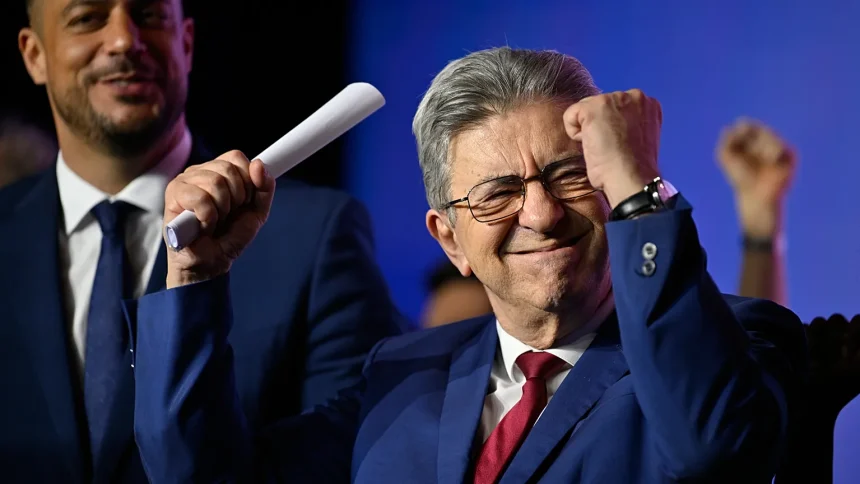
A new poll suggests Jean-Luc Mélenchon, leader of La France Insoumise, is increasingly well-positioned to reach the second round of France’s upcoming presidential election, a significant shift in a political landscape often dominated by other figures. The Toluna-Harris Interactive survey for M6 and RTL indicates Mélenchon could qualify for the run-off in three out of five scenarios tested, bringing a fresh dynamic to the contest eight months before voters head to the polls.
Mélenchon’s current polling numbers place him at over 16%, a notable increase from 12% in the institute’s previous April survey. This rise puts him within striking distance of figures like Édouard Philippe, who has typically been seen as the primary contender for the second spot behind Marine Le Pen and her Rassemblement National. The most favorable pathway for the LFI candidate appears to be a fragmented field, particularly when several centrist candidates vie for the same voter base. In one specific scenario, featuring Raphaël Glucksmann, Gabriel Attal, Bruno Retailleau of Les Républicains, and Philippe, Mélenchon registers 16% of the vote, surpassing Philippe at 14% and Glucksmann at 10%.
The political timing also seems to favor Mélenchon. Speaking to thousands of activists at LFI’s summer conference in Châteauneau-sur-Isère, he openly embraced his presidential aspirations, declaring that “Victory is possible.” During his nearly 45-minute address, Mélenchon broadened his message beyond protest, focusing heavily on economic and environmental policies. Amidst a summer marked by extreme weather, he advocated for an “ecological state” and a “clear and unequivocal break” from current policies, asserting that “Climate change is ushering in a completely new era for human civilisation,” demanding fundamental changes to how society lives, produces, and trades. He also sharply criticized Emmanuel Macron’s decade-long record, suggesting his departure was now “awaited on all sides as a liberation,” and vowed to seek a censure of Sébastien Lecornu’s government if its draft 2027 budget, which he believes would “worsen all the ills” of the French economy, is maintained.
However, Mélenchon’s upward trajectory coincides with a period of significant realignment on the French left. Raphaël Glucksmann, for instance, officially launched his own presidential bid, positioning himself as a social-democratic, pro-European alternative. Glucksmann, co-president of Place Publique, has explicitly called for the left to move beyond “Mélenchonism” and urged the Socialist Party against renewing its alliance with La France Insoumise. This call comes despite previous collaborations, such as the Nupes alliance for the 2022 parliamentary elections and the more recent New Popular Front after Macron’s dissolution of parliament in June 2024. Glucksmann currently polls at approximately 10%.
The Greens find themselves at a crossroads, with party leader Marine Tondelier seeking to maintain dialogue with LFI, while others within the party lean towards closer ties with Glucksmann and the Socialist Party. Green MP Jérémie Iordanoff has proposed a joint structure to unite these factions, and Yannick Jadot, the Greens’ 2022 presidential candidate, has already aligned himself with Glucksmann, arguing that Mélenchon’s politics are incompatible with Green values. These internal divisions highlight a perennial challenge for the French left: a crowded field of candidates risks fragmenting the vote in the first round. Mélenchon, however, remains unfazed by this prospect, summarizing his strategy by stating, “What matters is not the number of candidates, but the number of voters.”
Despite Mélenchon’s improved first-round prospects, a significant hurdle remains for any potential path to the Élysée. While the poll suggests he is increasingly competitive in the initial stage, the second-round run-off presents a far more challenging scenario. In a direct contest with Marine Le Pen, the survey indicates she would secure around 68% of the vote against Mélenchon’s 32%. Le Pen also defeats other tested candidates, though her margin against Édouard Philippe is considerably narrower. With the first round still scheduled for April 18, 2027, there is ample time for candidates to withdraw or enter the race, for new alliances to form, and for the broader political balance to shift. Yet, for now, the latest polling data offers Mélenchon a clear boost, reinforcing his strategic gamble that a fragmented opposition could indeed provide his route into the final two.