Tom Little/AFP via Getty Images
Europe was supposed to be winding down facilities like Kårstø. Instead, the giant Norwegian gas processing plant sits at the center of a broader continental shift: emission reductions are out, energy security is in.
Wars in Iran and Ukraine have upended Europe’s climate and clean energy plans, leaving the continent scrambling to lock in the gas it still needs to generate electricity, heat homes and run factories. European gas storage levels are near historic lows heading into winter, and many European leaders are wary of leaning too heavily on the United States, worried their energy needs could become leverage in trade and security talks with President Donald Trump. “We live in a world where dependencies can and are weaponized,” said Ann Mettler, a former adviser to ex-European Commission President Jean-Claude Juncker. “It’s understandable that the Europeans may have second thoughts.”
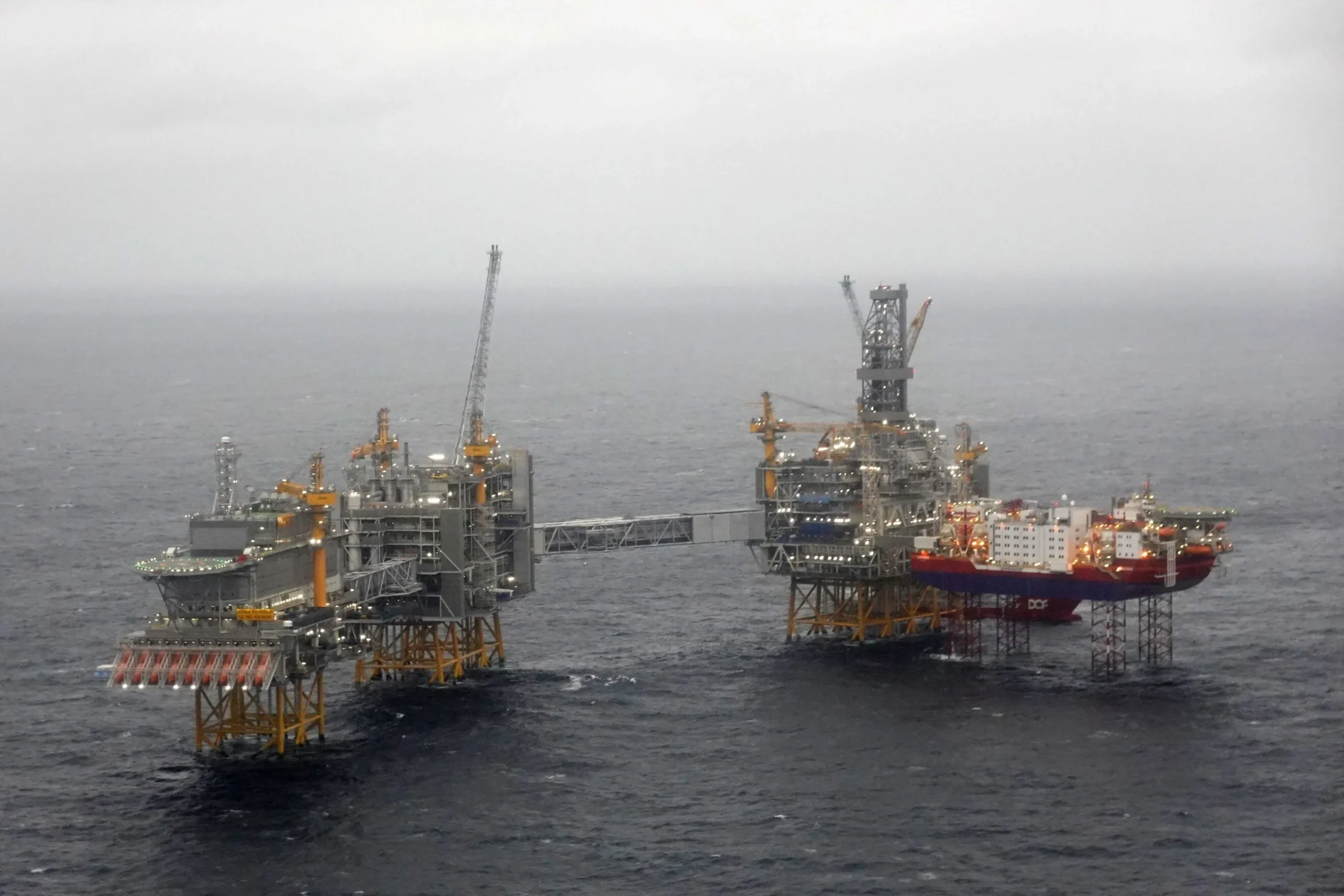
That’s where Kårstø comes in. An industrial sprawl of pipelines, distillation towers and flare stacks on the Norwegian coast, it’s the largest gas processing facility of its kind in Europe. Norway sits outside the EU and uses relatively little fossil fuel itself, yet it supplied nearly a third of the bloc’s gas and 14% of its crude oil last year, with roughly a quarter of Norwegian gas production passing through Kårstø on its way to pipelines feeding Belgium, France and Germany.
Production on the Norwegian continental shelf has been declining for a decade, but Europe’s renewed focus on energy security has sparked fresh interest in squeezing what’s left out of its subsea reservoirs. Equinor, Norway’s top oil and gas producer and the operator of Kårstø, embodies the shift: six years ago it announced a plan to invest heavily in renewables and hit net-zero by midcentury; this year it dropped its renewable target, though not the net-zero goal, to refocus on the continental shelf. “All my customers in Europe, they have a transition strategy and they’re working on investing in renewables. But they’re also securing long-term contracts for gas,” Equinor CEO Anders Opedal told POLITICO, shortly after signing a 15-year gas supply deal with German utility Uniper.
Norwegian officials are leaning into the role. The government, which owns a two-thirds stake in Equinor, has made the pitch explicit. “Our strategy is to be a long-term provider of oil and gas to the European market,” said Norwegian Energy Minister Terje Aasland. “Our target is not in numbers, but it’s to have as high production as possible.”
That ambition faces real limits. Norwegian oil and gas production is projected to fall by a third by 2050 in a best-case scenario, according to Torgeir Stordal, who heads the Norwegian Offshore Directorate; the agency’s baseline scenario has production falling by more than half. Industry executives argue more investment and new technology are needed to “flatten the curve,” and any real hope of slowing the decline rests on new discoveries in frontier areas like the Barents Sea, which would require bigger risk appetites, heavy spending and getting young Norwegians to move to remote parts of the country.
Not everyone in Norway is on board with the industry’s continued dominance. Green Party MP Frøya Skjold Sjursæther, whose party joined the governing coalition last year, pointed to the scale of oil-major sponsorship at Norway’s biggest energy conference as evidence of the industry’s political grip: “You can just see here when you’re walking around the center how much of a grip the oil gas producers have over Norwegian politicians, and [that] they can pretty much dictate the politics we’re having here. That’s really sad.” Some industry executives, meanwhile, argue Norway isn’t moving fast enough in the other direction. Aker CEO Johnny Hersvik pushed Aasland publicly to ease rules around new extraction technology, telling POLITICO afterward: “I don’t think there’s a sense of urgency, no.”
Norway has carefully calibrated its message to satisfy a Europe still nominally focused on climate without provoking a U.S. administration pushing its own fossil fuel dominance. Asked whether Norway competes with American LNG in Europe, Aasland said simply, “U.S. LNG is important for Europe to have energy security.” A White House spokesperson struck a similar note in a statement to POLITICO, crediting Trump’s “energy dominance agenda” for making the U.S. “the world’s largest producer and exporter of oil and natural gas,” with “an abundant and reliable supply for both our country and our allies.”
Mettler, who now leads the think tank Catalyse Europe, said Norway has simply learned to read the gap between what Europe says and what it does. Oil and gas still account for more than half the continent’s final energy consumption despite years of investment in renewables, EVs and heat pumps. “We say one thing, we moralize in public and we say we want to do these things, but then what we’re actually doing is buying a lot of LNG,” she said. “We haven’t delivered enough of a business case for clean energy in many instances. So that’s why a lot of the European oil and gas companies are sort of returning to their roots.”