
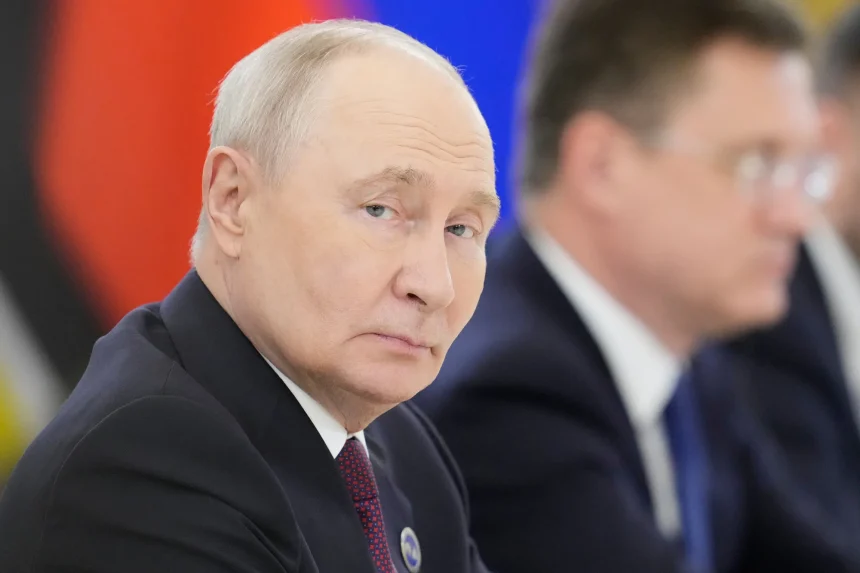
Vladimir Putin said Wednesday that Russia remains in close contact with Elon Musk and other American partners over low-Earth-orbit satellite operations, even as political tensions between Moscow and Washington remain largely unresolved. Speaking at an exhibition during the Russia-Africa summit in Moscow, Putin called Musk “a real genius” and framed the coordination in practical, operational terms rather than political ones.
His explanation centered on orbital traffic management rather than any broader partnership. We are in close contact with our American partners, including Mr. Musk, Putin said, because in orbit it is very important not to interfere with each other and to observe certain discipline and order, a description that frames the contact as the kind of technical coordination satellite operators routinely need to avoid collisions and signal interference, regardless of the political relationship between their home countries.
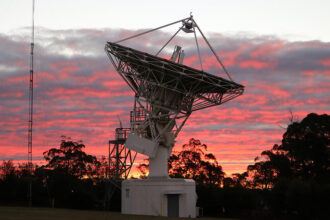
The remarks land against the backdrop of Russia’s own effort to build a domestic alternative to Musk’s Starlink network. Russia is developing Rassvet, a military-linked satellite constellation, with roughly 30 to 40 satellites already in orbit as of mid-to-late October and a stated target of 292 operational satellites by 2027, a scale that would still leave it well short of Starlink’s global footprint but would give Russia meaningful independent satellite internet and communications capability.
That context makes Putin's framing notable. Praising Musk personally while simultaneously racing to build a state-controlled rival constellation suggests Russia views coordination with SpaceX as a practical necessity for shared orbital space rather than a sign of warming relations more broadly. Low-Earth-orbit congestion has become a genuine operational concern as multiple countries and companies deploy large satellite networks, and avoiding collisions requires some degree of communication between operators almost by default.
Neither Musk nor SpaceX have publicly detailed the nature or scope of this coordination beyond Putin's own characterization of it, and no formal agreement between Musk and the Kremlin on satellite technology has been independently verified. The remarks stand, for now, as Putin's own account of a relationship that sits awkwardly alongside the broader state of US-Russia relations.
The comments underscore a recurring dynamic of the satellite era: orbital infrastructure increasingly requires a baseline level of cross-border coordination to function safely, even between countries, and individuals, whose relationship is otherwise defined by tension rather than cooperation.