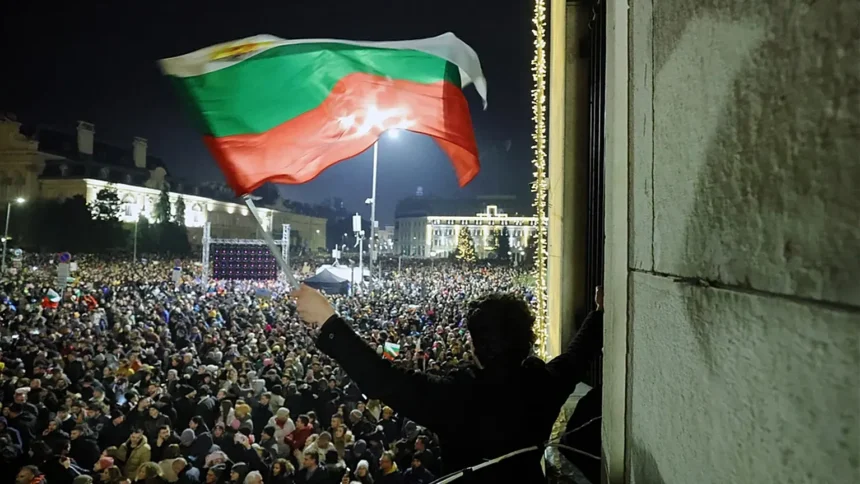
Tens of thousands of Bulgarians poured into the streets across the country on Wednesday, their collective voice demanding the resignation of Prime Minister Rosen Zhelyazkov’s center-right government. This widespread dissent, fueled by allegations of deep-seated corruption, saw estimations of over 100,000 demonstrators, with some reports claiming as many as 150,000, converging in the capital alone. The sheer scale of the protests, which dwarfed last week’s gatherings that drew more than 50,000, signaled a growing impatience with the political establishment.
The focal point of much of this anger appears to be Delyan Peevski, a prominent politician and oligarch whose Movement for Rights and Freedoms (DPS) party provides crucial support to the minority coalition government. Protesters in Sofia, gathering near the parliament, government, and presidency buildings, illuminated the parliament with laser projections bearing messages like “Resignation,” “Mafia Out,” and “For Fair Elections.” These pointed slogans underscore a public perception that the government’s policies are being shaped not by national interest, but by the influence of oligarchic interests, with Peevski at the center.
Peevski’s controversial history includes sanctions imposed by the US in June 2021 under the Global Magnitsky Human Rights Accountability Act, citing his “regularly engaged in corruption, using influence peddling and bribes to protect himself from public scrutiny and exert control over key institutions and sectors in Bulgarian society.” The United Kingdom followed suit in February 2023. Critics contend that despite DPS not being an official part of the governing coalition, its parliamentary votes are indispensable, granting Peevski significant leverage over decision-making within the country. This sentiment was visually represented in the protests by symbolic props like a large yellow sofa, labeled “Divan, Divan,” a play on words referencing one of Peevski’s MPs, Bayram Bayram, and the Bulgarian word for sofa.
Beyond Sofia, the wave of protest extended to more than 25 major cities, including Plovdiv, Varna, Veliko Tarnovo, and Razgrad. In Plovdiv, thousands gathered at Saedinenie Square, brandishing large Bulgarian flags and anti-government posters, while nearly 10,000 convened in Burgas, projecting their demands through sketches and videos on a video wall. The discontent even resonated internationally, with demonstrations organized by Bulgarians abroad in cities such as Brussels, London, Berlin, Vienna, Zurich, and New York, amplifying the call for the government’s resignation and better living and working conditions.
The demonstrations initially gained momentum last week in response to the government’s 2026 budget proposals, which included higher taxes, increased social security contributions, and spending rises. While the controversial budget plan was subsequently withdrawn, the protests have clearly evolved into a broader indictment of the government’s perceived lack of accountability and the pervasive influence of figures like Peevski. Opponents, including the opposition coalition We Continue the Change – Democratic Bulgaria, have seized the moment, calling for a no-confidence vote in the government, set for Thursday. This marks the sixth such motion by the opposition.
President Rumen Radev, from the political left, echoed the public sentiment on Facebook, characterizing Wednesday’s demonstrations as effectively a vote of “no confidence in the cabinet.” He implored lawmakers to “listen to the people” and to “choose between the dignity of free voting and the shame of dependence” ahead of the crucial vote. While the protests largely remained peaceful, Euronews Bulgaria reported 57 arrests in Sofia, with police attributing these to provocateurs rather than genuine demonstrators. This unrest unfolds as Bulgaria prepares to adopt the euro on January 1, 2025, a move that a June survey revealed to be almost evenly split in public opinion, with 46.8% opposing and 46.5% favoring the single European currency. The confluence of these factors paints a picture of a nation at a critical juncture, grappling with fundamental questions of governance and public trust.