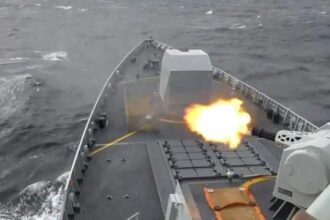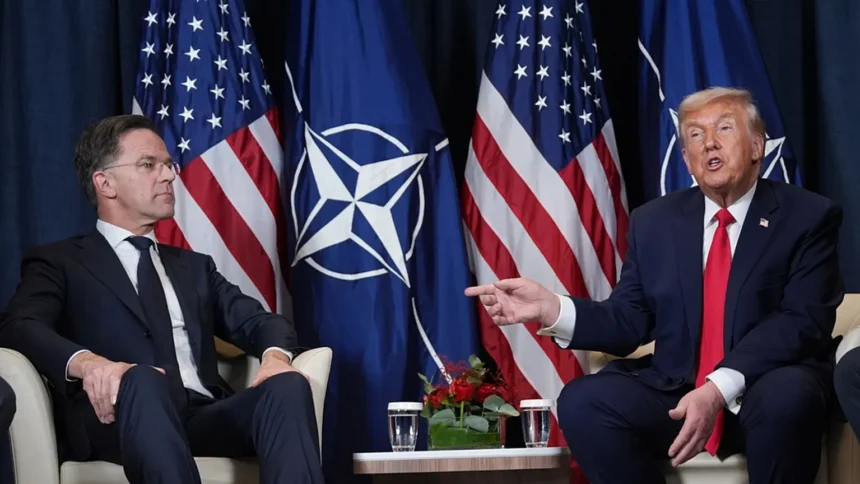
Recent weeks have seen renewed speculation regarding the United States’ continued commitment to NATO, particularly following pointed remarks from President Donald Trump. His characterization of the alliance as a “paper tiger,” coupled with threats of withdrawal, has ignited conversations about the mechanics of such a departure and its potential ramifications. These discussions intensified after European partners declined to participate in a naval force intended to reopen the Strait of Hormuz, a proposal that reportedly failed to garner widespread support.
The formal process for a nation to exit NATO is outlined in Article 13 of the 1949 North Atlantic Treaty. It stipulates that a country must formally notify the United States, which then informs the other member states. The withdrawal becomes official one year after this notification. While this appears straightforward for most member nations, the situation for the United States is uniquely complex. As both a member and the depositary of the alliance, the US manages the treaty texts and handles all accession and withdrawal notifications. In essence, the US government would inform its own Department of State of its intent to withdraw, which would then fulfill the depositary obligation of notifying other members. Should the US cease to be a member, it could, in theory, continue as depositary, though it is highly probable the remaining members would amend the treaty to assign those duties elsewhere.
However, domestic legal frameworks in the United States introduce significant hurdles to any presidential attempt to unilaterally leave the alliance. In 2023, legislation was enacted through an amendment to the National Defense Authorization Act for Fiscal Year 2024, requiring a two-thirds majority in the Senate or an Act of Congress for a president to “suspend, terminate, denounce or withdraw” from the North Atlantic Treaty. This measure also explicitly prohibits the use of federal funds to facilitate such a withdrawal. Rafael Loss, a policy fellow at the European Council on Foreign Relations, notes that this legislation makes it “formally very difficult” for a president to exit the treaty. Yet, he also acknowledges that differing legal interpretations regarding the competencies of various US legislative branches could arise, particularly if a president sought to challenge these restrictions. Any direct attempt by a president to withdraw without congressional approval would likely result in a legal battle, potentially reaching the Supreme Court, where arguments would center on presidential authority over treaties versus legislative checks.
Beyond the immediate legal challenge of formal withdrawal, another critical concern revolves around a “half exit” scenario. This involves the US remaining a member of NATO in name but significantly reducing its contributions and, crucially, abandoning its mutual defense obligations under Article 5 of the North Atlantic Treaty. Experts warn that such an outcome, given the US’s substantial resources, could fundamentally undermine the alliance’s operational capacity and its deterrent effect. Ian Bremmer, president and founder of Eurasia Group, articulated this concern, stating that while a president might not legally withdraw without Senate consent, if other members cannot trust the US to honor Article 5, the alliance is already broken where it matters most. Loss echoed this sentiment, suggesting that while a formal US withdrawal would cause “tremendous damage,” a clear, albeit damaging, exit might be preferable to an uncommitted member, as it would at least offer clarity and advance notice to other nations.
The implications of a diminished US role, whether through formal withdrawal or effective disengagement, would be profound for Europe and Canada. The US contributed approximately 60% of NATO’s total defense spending in 2025, an enormous gap that would need to be filled. Beyond financial considerations, a US departure would create critical vacancies in personnel, potentially limit access to US bases, and introduce widespread uncertainty regarding future US involvement in European security. While no country has ever fully left NATO, France, under President Charles de Gaulle in 1966, withdrew from its military command structure, offering a historical parallel. France remained a political member but ordered thousands of US troops to leave, and NATO headquarters relocated from Paris to Brussels. French generals ceased reporting to the Supreme Allied Commander Europe, traditionally a US citizen. France eventually rejoined the military command in 2009 under President Nicolas Sarkozy, demonstrating that even significant disengagement can be reversed, though the initial disruption was considerable. The prospect of the US becoming an indifferent member, as Loss suggested, presents a difficult gap for Europe to close, forcing a re-evaluation of its defense capabilities and strategic alignments.