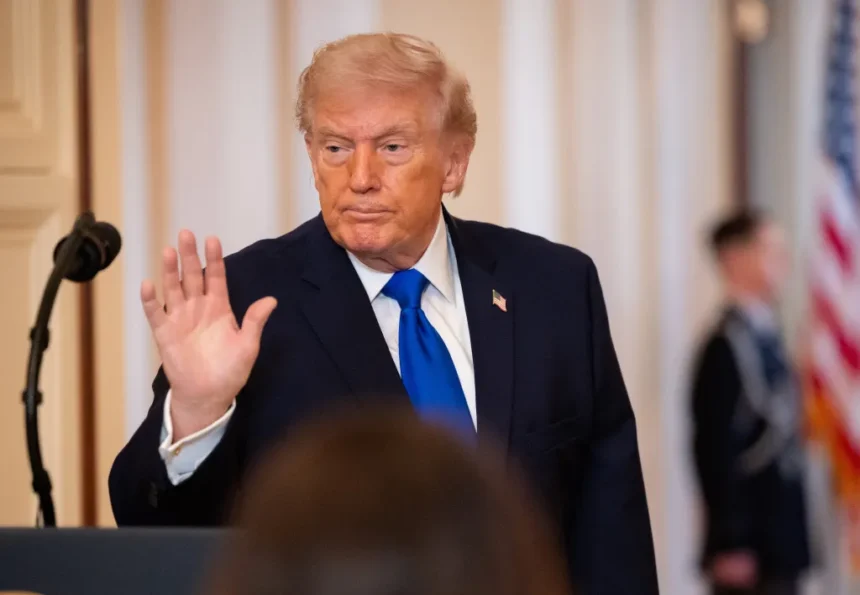
The landscape of international trade policy appears poised for significant upheaval, with President Donald Trump signaling an intent to pursue what he described as “much higher” tariffs, and potentially “terrible things” for foreign nations. This comes as markets react to a confluence of factors, including speculative blog posts and growing uncertainty surrounding trade relations. Yesterday, the S&P 500 experienced a 1.04% decline, and the VIX, often called the “fear index,” surged by 10%, reflecting a palpable unease among investors. While futures showed a slight rebound this morning, suggesting a temporary respite, the underlying tensions remain.
A recent blog post, which explicitly disavowed being “AI doomer fan-fiction,” inadvertently contributed to market volatility, highlighting what some analysts see as an oversensitive market. Both the Financial Times and The Wall Street Journal observed that the stock market has reached a point where even hypothetical scenarios or blog entries can trigger substantial shifts, suggesting an expensive market actively seeking reasons for a correction, potentially beyond the immediate influence of artificial intelligence narratives. This sensitivity underscores a broader fragility in current economic sentiment.
Adding to this precarious environment are the increasingly strained relations between the United States and its trade partners. There is growing frustration among countries that had previously secured low-level tariff agreements, now facing the prospect of rates as high as 15%. Conversely, nations that had previously endured higher tariffs after resisting the White House may now see a reduction to around 10%. Andy Haldane, the former chief economist and current president of the British Chambers of Commerce, noted to the BBC that this creates a perverse outcome where allies who negotiated favorable terms are now most disadvantaged. The CEO of Etihad Airways went as far as to state that this level of uncertainty is more challenging to navigate than periods of war.
Mr. Trump’s recent social media pronouncements further amplified these concerns, threatening countries that “play games” with what he termed the “ridiculous supreme court decision.” He asserted that the Supreme Court’s ruling “accidentally and unwittingly gave me, as President of the United States, far more powers and strength” than he possessed previously. He specifically mentioned the ability to use “Licenses to do absolutely ‘terrible’ things to foreign countries” and claimed the court had approved “all other Tariffs… in a much more powerful and obnoxious way, with legal certainty,” though he did not provide legal evidence for these assertions.
The legal basis for such potentially expansive tariff powers remains unclear. Joseph Brusuelas of RSM consulting firm suggested Section 122 of the trade act as one avenue, which allows for tariffs up to 15% in cases of “serious” balance-of-payments deficits or significant currency depreciation. However, Brusuelas questioned whether current U.S. economic conditions, balance of payments, or currency regime would meet these standards. Another possibility is Section 232 of the Trade Expansion Act of 1962, permitting tariffs for national security reasons, though this would necessitate prior investigations. William Bratton, an analyst at BNP, pointed to Section 301 tariffs, which have “no upper limit” and have historically proven “highly sticky,” as seen with those imposed on China in 2018. He warned these could theoretically be applied to any country unwilling to agree to trade agreements embedding higher tariffs with the U.S.
The cumulative effect of these uncertainties, from potential shifts in tariff policy to the broader economic implications, is likely to act as a drag on global trade, Gross Domestic Product, and inevitably, the stock market. Goldman Sachs analyst Pierfrancesco Mei provided some quantitative estimates, suggesting that an additional five percentage point increase in the effective tariff rate could boost core PCE inflation by 0.5 percentage points and reduce 2026 GDP growth by 0.4 percentage points, primarily through its impact on consumers and businesses. Mei further projected that a sustained 10% decline in equity prices through the second quarter of 2026 could reduce 2026 GDP growth by approximately 0.5 percentage points. This underscores the potential for significant economic reverberations should either the tariff landscape or market sentiment continue on their current trajectory.