
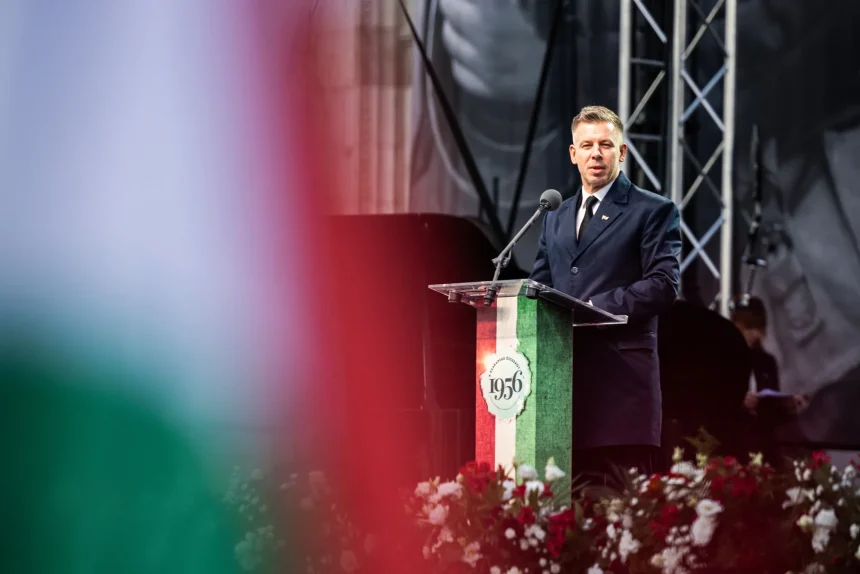
Hungarian Prime Minister Peter Magyar marked the anniversary of Hungary’s 1956 anti-Soviet uprising with a pointed declaration of his country’s renewed commitment to Europe, telling a crowd gathered before the parliament building on the Danube in Budapest that “Hungary can no longer be a ferry, drifting between west and east.”
The commemoration drew senior European officials to Budapest, including European Commission President Ursula von der Leyen and European Council President Antonio Costa, both attending at Magyar’s invitation as he works to rebuild ties with Brussels that frayed significantly under his predecessor, Viktor Orban.
Magyar took office in May after his center-right, pro-European Tisza party defeated Orban in a landslide April election, a result that handed Tisza a two-thirds majority in Hungary’s parliament and marked a sharp political turn after years of Orban’s more Moscow-aligned foreign policy.
The new government moved quickly on the European front, succeeding within just three weeks of taking office in unlocking €16.4 billion, roughly $18.4 billion, in previously frozen EU funds by implementing a rapid set of reforms demanded by Brussels.
By choosing the anniversary of the 1956 uprising, a defining moment of Hungarian resistance to Soviet domination, to make his pro-European statement, Magyar drew a deliberate symbolic line between his government's European orientation and the more ambivalent East-West positioning that characterized the Orban era.
The presence of top EU leadership at the commemoration signals how significant Brussels views Hungary's political reset, with the unlocked funding and renewed diplomatic warmth suggesting a substantive, not merely symbolic, shift in Budapest's relationship with the bloc.