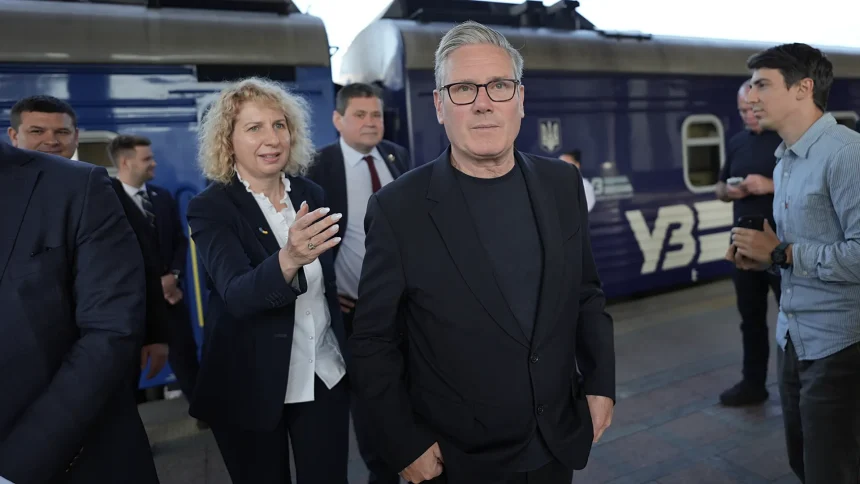
Keir Starmer, in his final overseas engagement as Prime Minister, traveled to Ukraine on Thursday, delivering a clear message of enduring British commitment to the besieged nation. The visit, just days before he formally hands over power, underscored a consistent foreign policy stance even as domestic political tides shifted. Starmer is scheduled to meet with Ukrainian President Volodymyr Zelenskyy, where discussions are expected to reinforce the continuity of support from London, particularly as Andy Burnham prepares to assume leadership next week.
“Our cast-iron support for Ukraine will always endure,” Starmer stated in remarks preceding his arrival, emphasizing the steadfast resolve of the United Kingdom. He further articulated admiration for the Ukrainian people’s resilience, noting their “incredible fortitude” and “iron will” in defending their freedom, which he contended has also safeguarded European security. This sentiment reflects a broader international consensus that Starmer has actively cultivated during his tenure.
The timing of this visit follows a significant development in Anglo-European cooperation regarding Ukraine. Britain recently joined the European Union’s €90 billion Ukraine Support Loan initiative. This strategic alignment grants British defense firms access to contracts funded by the extensive EU program. In return, the UK will contribute to a share of the annual interest rates, estimated at €3 billion, with the exact amount dependent on the level of engagement and benefit derived by its companies. Brussels has largely welcomed this agreement as a crucial step towards strengthening collective aid for Kyiv.
The impending change in UK leadership sees Burnham poised to become the fifth British Prime Minister since Russia’s full-scale invasion of Ukraine began in February 2022. He will officially take the helm of the Labour Party on Friday before his appointment by King Charles III on Monday. Starmer’s resignation last month, prompted by a loss of confidence within his own party following a series of domestic policy reversals, marked the end of a premiership that, despite internal challenges, maintained a strong international standing, particularly concerning Ukraine, NATO, and efforts to mend post-Brexit relations with Europe.
Starmer’s departure has led to the postponement of a planned UK-EU summit, originally slated for July 22. London anticipates resuming these high-level discussions with the new Prime Minister after the summer recess, indicating a desire to maintain the diplomatic momentum built during Starmer’s time in office. His role alongside French President Emmanuel Macron in advocating for Ukraine has been notable, particularly in establishing the “Coalition of the Willing.” This UK-France-led initiative has brought together over 30 countries to strategize on long-term security guarantees for Ukraine and to explore the potential for a multinational peacekeeping force should a peace agreement with Russia materialize. His final act on the international stage reinforces a legacy defined, in part, by this unwavering commitment.