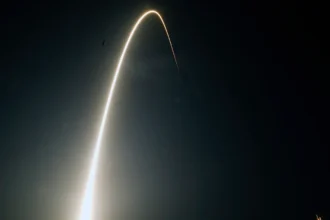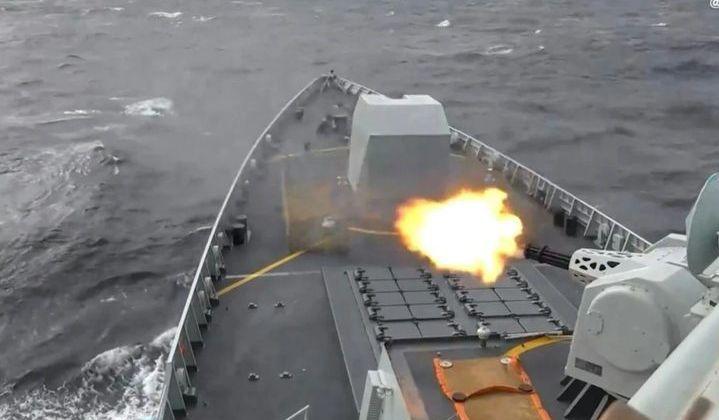
Taiwan’s skies and surrounding waters again became a contested zone this week as China launched rockets and deployed an array of military assets in what Beijing described as a rehearsal for blockading the self-governed island. These maneuvers, dubbed “Justice Mission 2025,” mark the most extensive Chinese war games to date in terms of their geographical coverage and proximity to Taiwan, occurring just 11 days after the United States announced an $11.1 billion arms package for the island nation. The Eastern Theatre Command confirmed live-firing exercises would extend until 6 p.m. in five distinct areas encircling Taiwan and off the Chinese coast, utilizing naval and air force units to practice strikes on maritime and aerial targets, alongside anti-submarine operations north and south of the island.
The recent escalation builds upon a pattern of increased military pressure from Beijing, representing the sixth significant round of such exercises since 2022, when then-U.S. House Speaker Nancy Pelosi visited Taiwan. Taipei is closely monitoring whether these current drills will include the firing of missiles directly over the island, a tactic previously employed by China. A senior Taiwan security official noted that Beijing appears to be using these exercises to simulate attacks on land-based targets, specifically mentioning the U.S.-made HIMARS rocket system. This highly mobile artillery system, with a range of approximately 300 kilometers, could potentially reach coastal targets in southern China, adding another layer of complexity to the strategic calculus.
President Lai Ching-te of Taiwan characterized China’s actions as “inconsistent with the conduct expected of a responsible major power” in a Facebook post, while affirming that Taiwan’s frontline troops were prepared for defense without seeking to escalate the situation. The island’s defense ministry confirmed live-firing drills had indeed taken place to Taiwan’s north on Tuesday morning, with debris subsequently entering its contiguous zone, an area extending 24 nautical miles offshore. While Reuters could not immediately verify rocket launches in all designated zones, the confirmation of activity in the north underscored the immediate nature of the threat.
The strategic importance of Taiwan in global commerce cannot be overstated. The Taiwan Strait serves as a critical artery for international shipping and aviation, facilitating an estimated $2.45 trillion in trade annually. The airspace above the island acts as a vital conduit connecting China, the world’s second-largest economy, with the rapidly expanding markets of East and Southeast Asia. Despite 11 of Taipei’s 14 flight routes being impacted by the drills, according to Taiwan’s Civil Aviation Authority, disruption to international air traffic has so far been minimal. Aviation analyst Li Hanming, based in the U.S., indicated that commercial carriers were largely utilizing two air corridors leading northeast toward Japan.
On the maritime front, 14 Chinese coastguard vessels maintained their presence around Taiwan’s contiguous zone on Tuesday, engaging in standoffs with Taiwanese counterparts. A Taiwan coast guard official detailed a “one-to-one parallel navigation approach,” where vessels closely shadowed each other. The Taiwanese side reportedly employed “wave-making and maneuvering techniques” in an attempt to compel Chinese vessels to retreat. In the 24 hours leading up to 6:00 a.m., Taiwan’s defense ministry reported the presence of 130 Chinese military aircraft and 22 navy and coastguard vessels operating in the vicinity of the island.
Beijing’s intensified rhetoric and military posturing also follow recent remarks by Japanese Prime Minister Sanae Takaichi, who suggested last month that a hypothetical Chinese attack on Taiwan could potentially elicit a military response from Tokyo. Chinese state media has been actively engaged in propaganda efforts, including a poster titled “Hammers of Justice” depicting Taiwan President Lai Ching-te being crushed by two hammers striking the island’s north and south. The drills have also seen the first deployment of the Type 075 amphibious assault ship, a vessel capable of simultaneously launching attack helicopters, landing craft, amphibious tanks, and armored vehicles, as explained by Zhang Chi, an academic at China’s National Defense University. This new ship, alongside an AI-generated video released by the Chinese military showcasing automated humanoid robots and weaponized robotic dogs, underscores the multifaceted nature of Beijing’s military projection. Chinese media maps illustrate the encirclement of the island, with Taiwan’s defense ministry noting that five of the seven designated live-fire zones overlap with Taiwan’s territorial waters, extending 12 nautical miles from its coast. The Chinese military stated its forces were drilling sea-based assaults, air defense, and anti-submarine operations, aiming to test the “ability to coordinate for integrated containment and control,” specifically simulating a blockade of Taiwan’s crucial deep-water ports of Keelung and Kaohsiung.