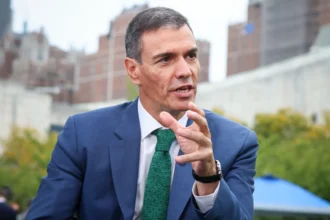
The arrival of 50,000 migrants in Ceuta from Morocco in a single day, an event Spanish Prime Minister Pedro Sánchez characterized as an “attack” and a “violation of Spain’s territorial integrity,” has ignited a sharp debate within the European Union regarding solidarity and border management. Sánchez, in a letter sent to European Commission President Ursula von der Leyen, expressed frustration over what he perceives as an uneven and, in some instances, unsupportive reaction from certain EU member states. His communication, dispatched last Saturday, highlighted concerns about misinformation, underlying prejudices, and political opportunism influencing the European response.
While many EU partners offered support and assistance, Sánchez noted a “rather asymmetric” reaction from others. He pointed out that while breaches of national borders typically draw swift condemnation and are often framed as hybrid attacks, some countries instead called for stricter controls on Spain, urging Madrid to restore order rather than offering solidarity. This sentiment was particularly directed at the Italian government, led by Prime Minister Giorgia Meloni, which announced an intention to suspend freedom of movement with Spain shortly after the Ceuta incident. The practical implications of such a measure remain unclear, but it underscores the friction emerging within the bloc.
Sánchez implicitly rebuffed Italy’s stance on irregular migration within his letter, asserting that Spain maintains “one of the least porous external borders of the European Union,” a claim supported by Frontex data. He argued that the EU cannot afford “this kind of selfish, polarising and unlawful reaction” given the current international climate. This internal criticism comes amidst broader scrutiny of Spain’s plans to regularize the status of 500,000 undocumented individuals living and working within its borders. Madrid defends this decision, which was not made in consultation with the EU, as a move to grant social rights to those already integrated into Spanish society. However, this has drawn criticism from conservative and right-wing governments across Europe, who fear it could encourage further irregular arrivals.
Spanish officials have been quick to differentiate the regularization process from the events in Ceuta, insisting the two are unrelated. They view the Ceuta situation as an assault on territorial integrity, rather than solely a migrant crisis. Sánchez used his letter to defend Spain’s handling of the influx, noting that border control was re-established within 48 hours, humanitarian aid was provided, and nearly all irregular entrants were returned. These actions, he stated, were coordinated with Moroccan authorities, with limited assistance from other European nations. The EU had indicated its readiness to deploy more Frontex resources, though Spain did not request them.
The Spanish Prime Minister also reminded EU members of Spain’s past solidarity during similar crises, referencing the 2021 border situation involving Belarus and Eastern European countries, as well as the surge in migrant arrivals on the Italian island of Lampedusa in 2023. The underlying cause of the mass crossing into Ceuta remains officially unconfirmed, though similar incidents have coincided with periods of diplomatic tension between Morocco and Spain in the past. Rabat has denied any instrumentalization of migration for political ends.
In the aftermath, Sánchez formally requested an urgent video conference of EU interior ministers from the European Council. He emphasized the need for a unified European response and a reaffirmation of the protection of the EU’s external borders, framing this as a shared responsibility rather than one falling solely on frontline states. While European Council chief Charles Michel expressed solidarity with Spain, Ursula von der Leyen’s comments focused on returns, labeling the scenes in Ceuta “unacceptable” and attributing blame to human traffickers. Separately, a group of 22 member states, led by Italy and Denmark, called for emergency talks to strengthen Europe’s external borders, even suggesting internal checks if necessary. Notably, Spain’s direct neighbors, Portugal and France, did not sign this letter. Sánchez concluded his message to von der Leyen by urging her to demonstrate leadership and ensure a swift, effective, and coordinated EU response to the Ceuta situation.