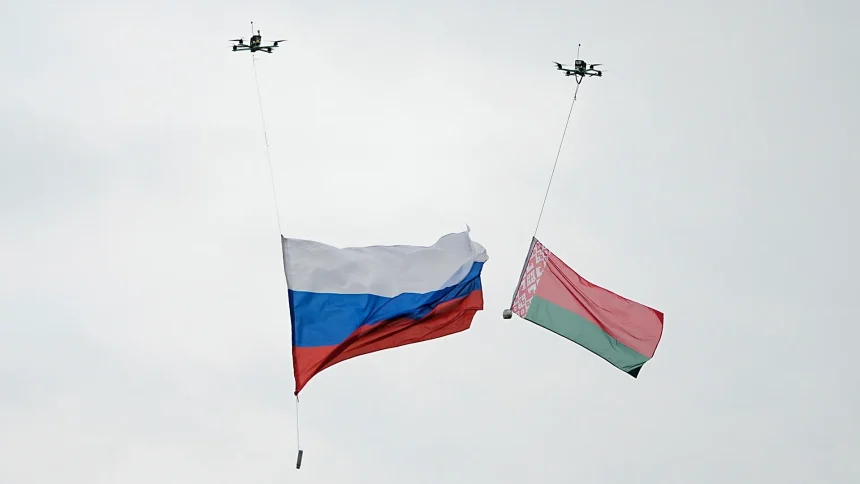
A drone, identified as originating from Belarus, was shot down over Lithuanian airspace early on Tuesday, marking the first such incident for the NATO member state. The unmanned aerial vehicle traversed areas including Lentvaris, near the capital Vilnius, before being intercepted close to the village of Pratkūnai. This event immediately brought renewed scrutiny to Minsk’s involvement, not just in facilitating Russian attacks against Ukraine, but now as a direct source of potential aerial threats to NATO territory itself. The incursion occurred merely a day after Ukrainian officials detailed how Russia was reportedly leveraging Belarusian mobile networks and signal repeaters to bolster Shahed-type drone operations during recent assaults on western Ukraine.
Ukrainian President Volodymyr Zelenskyy’s advisor, Serhii “Flash” Beskrestnov, observed that the flight paths of Russian drones during a significant Saturday attack indicated a reliance on mobile networks situated across the Belarusian border. He specifically noted that both jet-powered and conventional Shaheds maintained proximity to Belarus’s frontier, suggesting they were likely accessing Belarusian commercial LTE networks for communication and guidance. This observation was reinforced by Ukraine’s State Border Guard Service, which separately stated on Monday that recent Russian attacks targeting regions like Rivne, Volyn, and Lviv in western Ukraine had communications support originating from within Belarus. Border guard spokesperson Andrii Demchenko elaborated, claiming that the air assets launched by Russia were supplied with signals transmitted through repeaters positioned precisely on Belarusian soil.
These assertions collectively indicate a pattern: Russia is once again utilizing communications infrastructure inside Belarus to support its drone campaign against Ukraine, despite earlier demands from Kyiv for the equipment to be deactivated. The presence of such technology has been a persistent point of contention between Ukraine and Belarus since June. At that time, Ukraine’s military intelligence chief, Oleh Ivashchenko, revealed that Kyiv had identified six repeater stations in Belarus dedicated to relaying video streams from Russian strike drones, with some of this equipment reportedly reactivating. President Zelenskyy had issued an ultimatum to Belarus, giving it a week to dismantle or switch off these Russian-installed repeaters, threatening Ukrainian action if his demands were not met.
For a brief period, it appeared the Ukrainian pressure had yielded results. Days after Zelenskyy’s warning, the repeaters reportedly ceased operations on June 22, though whether they had been physically removed remained unclear. This cessation, however, proved to be temporary. By the end of June, Ukrainian military officials reported that the equipment had not been dismantled, and at least one repeater had been reactivated. The apparent return of these capabilities provides Russia with another vital means of maintaining communication with its long-range strike drones, particularly those operating near Ukraine’s northern and western borders. These areas are, in many instances, uncomfortably close to NATO territory, adding a layer of strategic concern for the alliance.
Russia has increasingly adopted a hybrid approach, combining mobile networks with traditional radio technology, to ensure consistent links with its strike drones. This strategy aims to overcome Ukrainian electronic warfare efforts, which have proven effective in disrupting drone operations. The recent incident over Lithuania, coupled with the detailed reports from Ukrainian intelligence regarding Belarusian communication infrastructure, underscores a deepening entanglement of Belarus in Russia’s military actions. It not only highlights Minsk’s continued role in enabling Moscow’s attacks on Ukraine but also projects the potential for direct implications for NATO’s security perimeter, as demonstrated by the drone’s flight path deep into Lithuanian airspace. The evolving nature of this support system suggests a persistent challenge for regional stability and collective defense.