The eurozone saw inflation continue its downward trajectory in January, registering its lowest level since September of the previous year and falling beneath the European Central Bank’s medium-term target. This latest flash estimate from Eurostat indicates annual inflation across the euro area eased, aligning with market expectations. The overall monthly contraction of 0.5% in consumer prices marked the steepest fall recorded since November 2023, signaling a persistent disinflationary trend across the bloc.
Delving deeper into the figures, core inflation, often seen as a more reliable indicator because it filters out volatile energy and food prices, also saw a modest decline. It edged down from 2.3% to 2.2% year-on-year, reaching its lowest point since October 2021. While services still reported the highest annual rate at 3.2%, this was a slight decrease from the previous 3.4%. Food, alcohol, and tobacco, however, experienced a marginal acceleration to 2.7%. Non-energy industrial goods showed a muted increase of 0.4%, but perhaps most notably, energy prices plummeted by 4.1%, a more significant drop than the 1.9% decline observed the month prior.
Among the larger economies within the euro area, inflation remained subdued. Germany’s estimated annual rate stood at 2.1%, closely mirroring the overall euro area average. Italy reported an even lower 1% inflation, which some analysts attribute to weak domestic demand. France presented a particularly striking figure with an estimated 0.4% reading, the lowest across the bloc, highlighting the strength of its recent disinflationary pressures. In contrast, Slovakia registered the highest annual inflation at 4.2%.
This continued easing of inflation, however, is not universally viewed as an unmitigated positive. Joe Nellis, emeritus professor and economic adviser at MHA, cautions that this disinflationary trend is partly a symptom of lackluster demand. He suggests that reduced economic growth over recent years has dampened demand, thereby contributing to the downward pressure on inflation. While falling energy prices have certainly played a role in this slowdown, the persistence of core inflation, despite its softening momentum, remains a point of observation for economists.
With inflation now hovering near the target and economic growth remaining subdued across much of the euro area, Nellis argues there is little rationale for further monetary tightening. For businesses, the landscape is becoming more predictable. Inflation aligning closer to the target offers clearer visibility on costs and pricing strategies. Borrowing costs, though still elevated compared to pre-pandemic levels, have retreated from their earlier peaks and could potentially ease further as 2026 progresses. Nevertheless, a gradual recovery in consumer demand is anticipated as real incomes slowly rebuild.
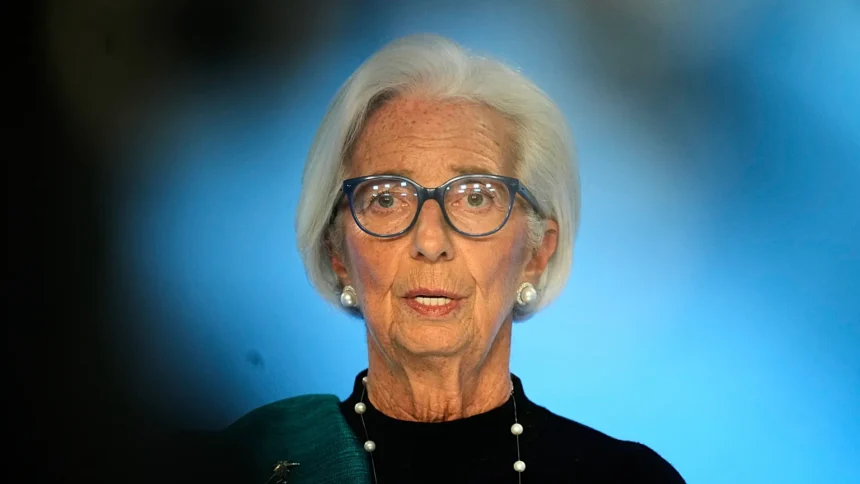
Looking ahead, the European Central Bank is widely expected to maintain interest rates at its upcoming Governing Council meeting, the first of the year. Alexandre Strott, an economist at Goldman Sachs, anticipates an uneventful meeting, suggesting that incoming data largely aligns with staff projections, and policymakers likely consider the current stance appropriate. Therefore, ECB President Christine Lagarde is expected to reiterate, for the sixth consecutive meeting, that the policy is in a “good place.”
Roman Ziruk, senior market analyst at Ebury, points to the broader inflation backdrop indicating contained price pressures, with an increasing risk of inflation undershooting the target. He notes that the rapid appreciation of the euro has a non-negligible impact on lowering import prices, although this also affects export competitiveness, a crucial factor for the euro area economy. This evolving situation has led markets, which only weeks ago were leaning towards a rate hike, to now price in a one-in-five chance of a rate cut before the year’s end. Ruben Segura-Cayuela, an economist at Bank of America, expects the ECB to maintain a cautious approach. He believes that the uncertainty that underpinned Lagarde’s prudence in December has only intensified. Bank of America, for its part, projects a 25 basis point rate cut in March 2026, which they see as the final reduction in the easing cycle, followed by an extended period of holding rates through 2026 and 2027. Despite these developments, financial markets showed a limited reaction to the data, with the euro steady against the dollar and German Bund yields largely unchanged. Eurozone equities saw a slight uptick, with the Euro STOXX 50 rising, and national benchmarks presenting a mixed but generally positive picture.