
Deep inside the Arctic Circle, more than 1,000 meters underground, the smell of ammonia lingers in the tunnels of the Malmberget mine in Northern Sweden after nightly explosions that loosen 50,000 tons of rock.
Photo: Carsten Snejbjerg/Bloomberg
For more than a century, the mine has churned out iron ore and played a central role in Sweden’s economic history. Now those same blasting operations are the first stage of a much bigger quest: to build a viable supply chain for rare earths inside Europe.
Why rare earths matter
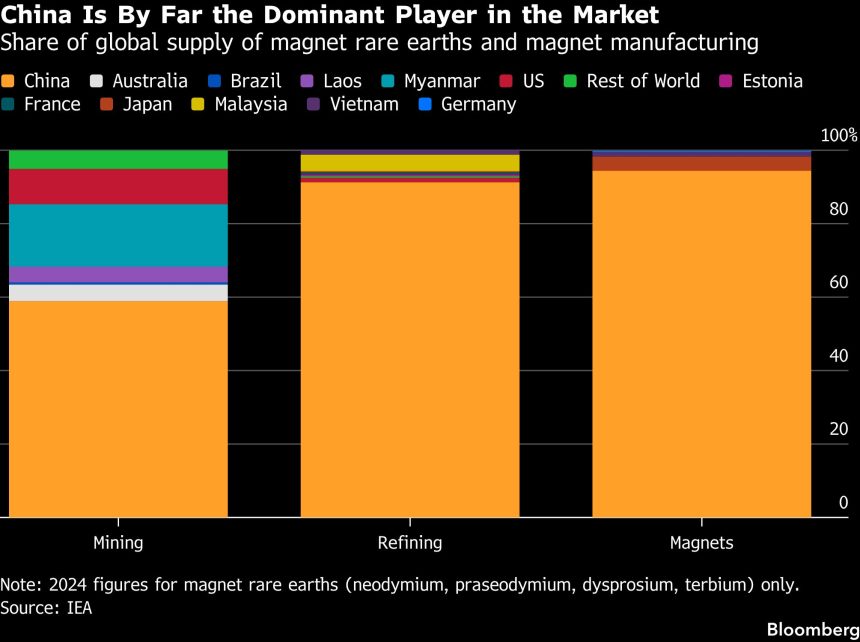
These minerals have become some of the 21st century’s defining commodities. They are used in electric cars, wind turbines, data centers, smartphones and defense equipment. As demand rises, so does the strategic risk of relying on a single dominant supplier. China currently controls the bulk of global rare-earth processing, giving it enormous leverage over European industry.
Reducing that dependence has become one of the EU’s most urgent economic security priorities. The bloc’s Critical Raw Materials Act has earmarked dozens of strategic projects across the continent, with the Nordic region emerging as the cornerstone of the effort.
The Nordic advantage
The north of Europe combines the continent’s largest known rare-earth deposits with abundant clean power and decades of mining expertise. Sweden’s state-owned LKAB, which runs Malmberget, is in an unusually strong position because the rare earths are a by-product of its profitable iron-ore business. That means it does not have to build an entirely new mining operation from scratch.
But extracting ore is only the beginning. Turning it into usable materials requires processing and refining capacity, and that is where Europe has lagged far behind China. Beijing’s dominance was built not only on geology but on decades of government-backed investment across the full supply chain.
Borrowing from China's playbook
To catch up, EU officials and industry executives say Europe needs to adopt parts of the Chinese model. That means using public money, long-term offtake agreements and regulatory support to build processing plants that private investors would otherwise consider too risky or too slow to pay off.
"In the West, if we really want to win this whole chain of how rare earths work, you need to think like China, not just about the rare earth mine," said Eldur Olafsson, chief executive of Amaroq Ltd., which has an exploration project in Greenland.
The price tag
The European Commission estimates that completing the strategic projects mapped out under the Critical Raw Materials Act will cost more than EUR 43 billion, or about $48 billion. That is far above the funding currently available.
The cost of inaction may be even larger. The International Energy Agency has warned that supply disruptions in critical minerals could inflict a $1.5 trillion hit on the global economy, with automakers, electronics makers and aviation among the hardest-hit sectors.
What comes next
Brussels is expected to rely on a mix of public resources and private investment to close the gap. The question is whether EU governments can move quickly enough to turn Nordic ore into refined materials before the next geopolitical shock exposes the depth of the continent's import dependence.