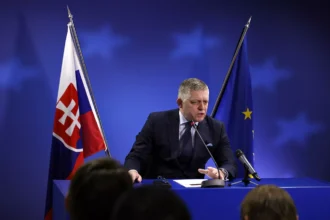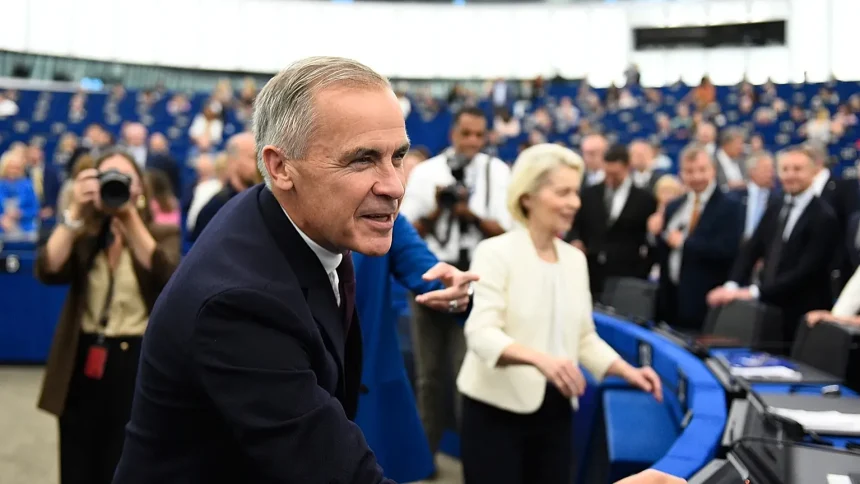
European Commission President Ursula von der Leyen recently extended an invitation to Canada, proposing it become the European Union’s inaugural “associate member.” This announcement, delivered during her 2026 State of the Union address, saw Canadian Prime Minister Mark Carney in attendance, underscoring the immediate relevance and high stakes of the proposition. The move comes as Canada actively seeks closer ties with Europe amidst a trade dispute with the United States, positioning itself for a deeper relationship that stops short of full EU membership, an option geographically impossible for a non-European state.
The concept of “associate member” represents a novel category within the EU’s complex web of international relationships. While countries like Norway and Switzerland already enjoy significant integration into the EU’s single market through various agreements, and the United Kingdom maintains a broad trade and cooperation deal post-Brexit, Canada’s potential status introduces an entirely new framework. These existing arrangements often grant access to the free movement of goods, persons, services, and capital, and facilitate collaboration on initiatives like joint defense or research programs such as Horizon Europe. However, they typically exclude any say in EU legislative processes.
Prime Minister Carney’s presence in Strasbourg and his previous statements about forging a “unique alliance” with the EU had set expectations high for von der Leyen’s address. She articulated a shared vision, emphasizing common values and a commitment to democracy. “We share one ocean, one set of values, one way of seeing the world. And we will now build our shared future as well,” von der Leyen remarked, highlighting the alignment between Ottawa and Brussels on principles such as human rights, democracy, and the rule of law – fundamental criteria for any form of EU association.
Discussions are already underway between Ottawa and Brussels regarding practical aspects of this potential new relationship. Euronews has reported that Canada is exploring participation in the Erasmus+ exchange program, accessing Horizon Europe research grants, and establishing mutual recognition of workers’ qualifications. These areas suggest an intent for deep, practical cooperation across various sectors, from academic and scientific exchange to professional mobility.
A key question surrounding this nascent “associate member” status concerns potential voting rights within EU institutions, a privilege not typically afforded to non-member states, even those closely integrated like Norway and Switzerland. German Chancellor Friedrich Merz had previously floated a similar concept in May for Ukraine, suggesting an associate membership could grant access to decision-making bodies such as the European Council, European Commission, and European Parliament, but without voting power or a dedicated portfolio. Such a model would also allow for gradual access to EU-funded programs. While Canada’s circumstances differ significantly from Ukraine’s wartime context, the underlying principle of a structured, deep engagement without full membership privileges appears to be a consistent theme.
Von der Leyen’s address also outlined a broad scope for this new alliance, extending beyond economic ties to include cooperation in technology, defense, Arctic joint projects, energy, critical minerals, and artificial intelligence. She explicitly referenced moving “from CETA to an Alliance for the Future to create a common prosperity and economic security space,” referring to the 2016 EU-Canada trade agreement that eliminated tariff barriers. This suggests an evolution from a purely trade-centric relationship to a more comprehensive strategic partnership.
The announcement sends a potent political signal in a global landscape marked by shifting alliances. Von der Leyen’s assertion that “Democracies have the freedom to choose with whom to work” underscores a deliberate strategic realignment. The deeper economic and security cooperation anticipated from this new status is expected to be a central topic at an upcoming summit in Montreal this October, where the specifics of this unprecedented association will likely begin to take clearer shape.