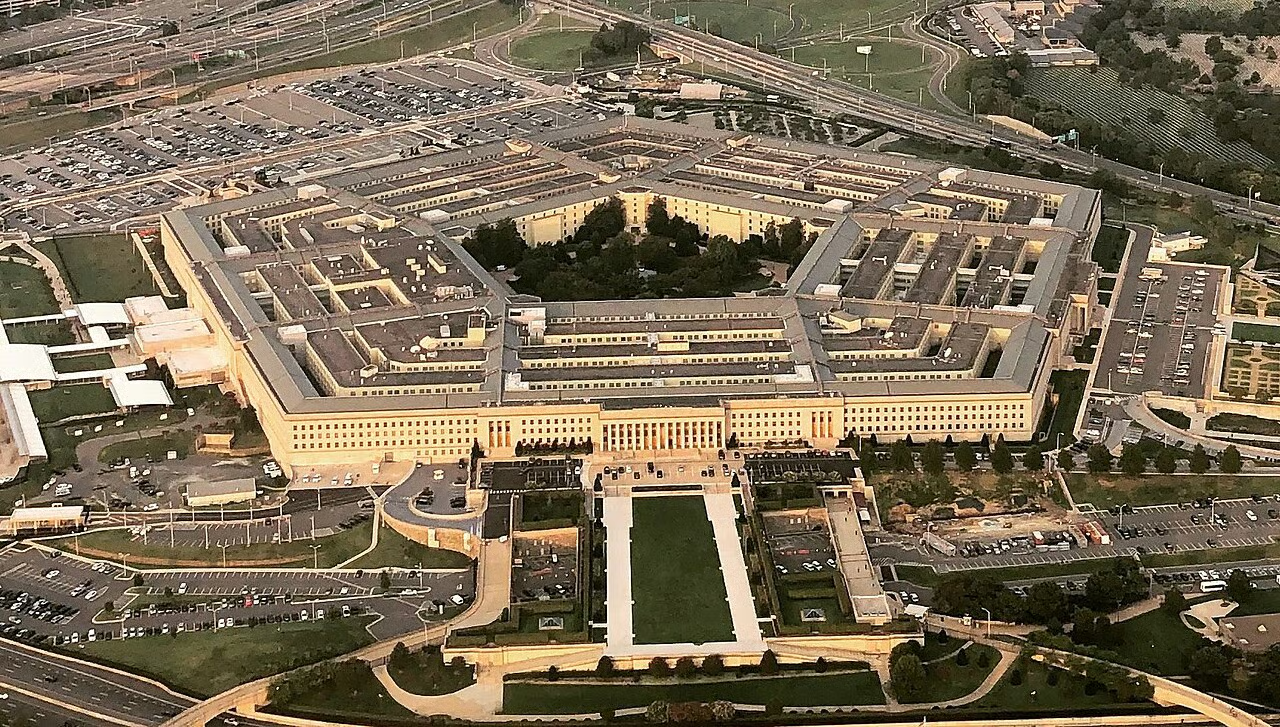
The collaboration between Anthropic, a prominent artificial intelligence research company, and the U.S. Department of Defense has drawn considerable attention, prompting discussions around the ethical implications of advanced AI in military contexts. This isn’t a new phenomenon; the intersection of cutting-edge technology and national security has always been a complex landscape. However, the rapid advancements in large language models, like those developed by Anthropic, introduce a new layer of considerations, particularly regarding autonomy, decision-making, and the potential for unintended consequences in high-stakes environments.
Details of the partnership surfaced through various reports, indicating that Anthropic’s AI models are being explored for applications ranging from logistical optimization to information analysis within the Pentagon. The Department of Defense has long sought to leverage technological advantages, and AI’s capacity to process vast amounts of data and identify patterns offers a compelling proposition for enhancing operational efficiency and strategic intelligence. Proponents argue that AI can reduce human error in complex tasks, accelerate response times, and provide critical insights that human analysts might miss under pressure. The focus appears to be on improving existing processes rather than developing fully autonomous weapons systems, a distinction that Anthropic itself has emphasized in its public statements regarding its ethical guidelines.
Despite these assurances, the involvement of a leading AI developer like Anthropic with a military entity inevitably raises concerns among ethicists and the broader public. The core of the apprehension often lies in the “dual-use” nature of AI technology; tools designed for benign or assistive purposes can, in different contexts, be adapted for more aggressive applications. There is a palpable fear that even if initial deployments are limited to non-lethal support functions, the trajectory of such partnerships could lead to increasing autonomy in military decision-making, potentially blurring the lines of human accountability. Safeguards and robust ethical frameworks are frequently cited as essential, yet their effective implementation in rapidly evolving technological landscapes remains a significant challenge.
Anthropic, known for its commitment to “safe and responsible AI,” has positioned itself as a company dedicated to exploring beneficial AI applications while actively mitigating risks. Their stated approach involves extensive research into AI safety, including the development of “constitutional AI” that aims to imbue models with ethical principles. This philosophy underpins their engagement with the Pentagon, suggesting an attempt to guide the responsible integration of their technology rather than simply providing it without oversight. However, critics often argue that the inherent nature of military operations, with its emphasis on strategic advantage and rapid deployment, can create pressures that challenge even the most well-intentioned ethical guidelines.
The discourse surrounding this collaboration extends beyond the immediate applications to the broader implications for the AI industry. As more AI companies consider or enter into partnerships with defense organizations, the precedent set by Anthropic could influence future engagements. It highlights the ongoing tension between technological innovation, economic opportunity, and ethical responsibility in a sector that is increasingly central to global power dynamics. Understanding the specifics of these partnerships, the stated goals, and the ethical guardrails being put in place becomes crucial for assessing the long-term impact on both AI development and international security. The conversation is far from over, and its evolution will undoubtedly shape the future landscape of artificial intelligence.