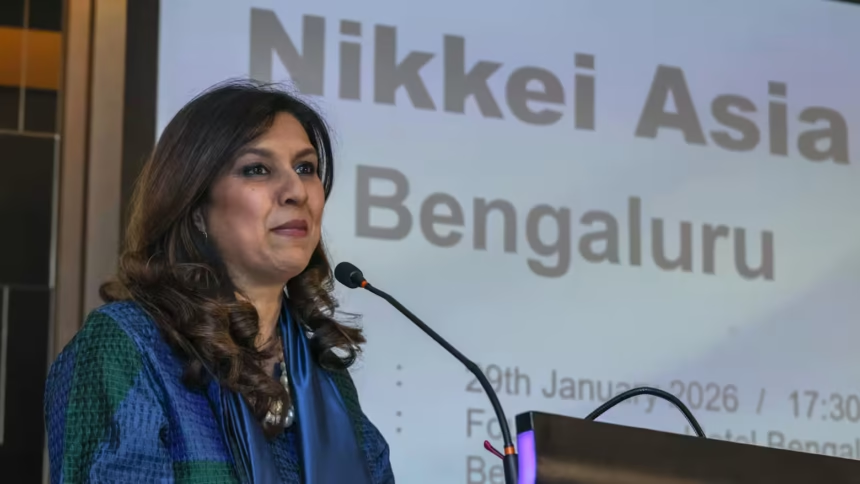
The Confederation of Indian Industry views the current landscape of international trade, particularly the emergence of tariff disputes, as a significant catalyst for strengthening economic ties between India and Japan. This sentiment was articulated by Geetanjali Vikram Kirloskar during the Nikkei Asia Forum held in Bengaluru on January 29th. Her remarks underscored a growing conviction within India’s business community that present global challenges are, in fact, creating new avenues for collaboration and mutual growth between the two nations.
Kirloskar’s perspective suggests a strategic reassessment of global supply chains and investment flows, where traditional partnerships are being reevaluated and new alliances forged. The prevailing atmosphere of trade protectionism, rather than isolating economies, appears to be fostering a more concentrated effort among certain countries to deepen their bilateral relationships. For India and Japan, this translates into an amplified focus on areas of economic cooperation that extend beyond conventional trade agreements. The discussions in Bengaluru highlighted what many see as an “enormous potential” for Japanese enterprises within the Indian market, a potential that is increasingly being recognized and pursued by both sides.
This deepening engagement is not merely a reaction to external pressures but also reflects a natural alignment of economic interests and complementary strengths. Japan, with its advanced technological capabilities and significant capital resources, finds in India a vast and rapidly expanding market, a burgeoning consumer base, and an increasingly skilled workforce. Conversely, India stands to benefit from Japanese investment in infrastructure, manufacturing, and technology transfer, all crucial components for its continued economic development and modernization efforts. The CII, as a prominent voice for Indian industry, plays a pivotal role in facilitating these connections, acting as a bridge between policymakers and businesses in both countries.
The forum in Bengaluru served as a platform for these ideas to be exchanged and for future strategies to be discussed. Such events are instrumental in translating high-level policy discussions into tangible business opportunities. They allow for direct interaction between industry leaders, fostering a shared understanding of market dynamics and regulatory frameworks. The emphasis on regional cooperation, as articulated by Kirloskar, points towards a broader vision where India and Japan are not just partners but also anchors of stability and growth within the Asian economic framework, particularly in a period marked by global uncertainties.
The narrative emerging from these discussions is one of proactive engagement rather than passive adaptation. It suggests that while tariff wars might present immediate challenges, they also compel nations to innovate and diversify their economic partnerships. For Indian and Japanese businesses, this means exploring new sectors, investing in joint ventures, and collectively navigating the complexities of the global marketplace. The “tailwinds” mentioned by Kirloskar are not just about avoiding trade barriers but about leveraging a unique moment to build a more robust, resilient, and mutually beneficial economic relationship that can withstand future disruptions. The long-term implications of this strengthened partnership could redefine regional economic dynamics, offering a model for collaboration in an increasingly fragmented global economy.