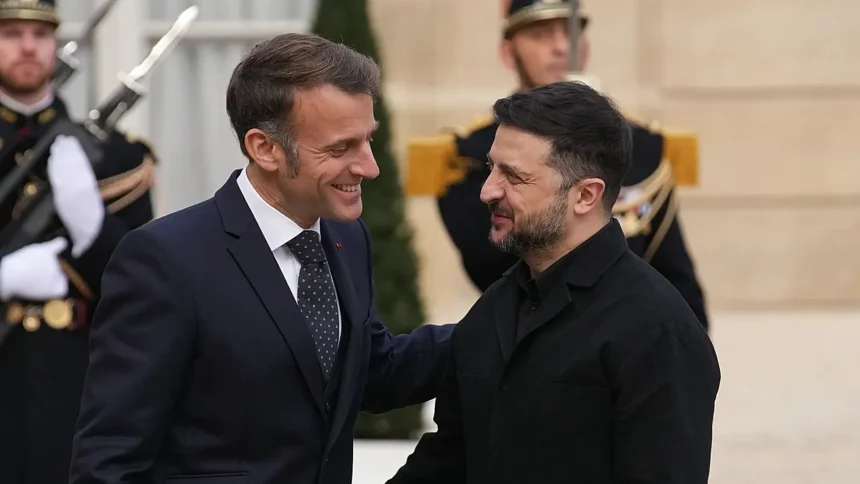
Ukrainian President Volodymyr Zelenskyy arrived in Paris for high-stakes peace talks with French President Emmanuel Macron, marking a pivotal moment in Europe’s effort to shape an endgame for the war that has now stretched past its thousandth day. The visit comes as international pressure intensifies for a negotiated settlement—pressure complicated by shifting U.S. positions and a dramatically evolving battlefield.
- A Paris Summit Shaped by Urgency and Uncertainty
- Trump’s Comment on the Peace Framework Complicates Diplomacy
- Europe Seeks to Step Forward as U.S. Signals a More Conditional Role
- Ukraine’s Strategic Position: Fighting While Negotiating
- Russia Watches Closely but Remains Unmoved
- The Stakes: Europe Fights for Diplomatic Relevance
- A Fragile Moment for Peace
- Conclusion: A Peace Effort in Motion, But Far From Resolution
The centerpiece of the talks is a 28-point peace framework drafted by European mediators and endorsed by Kyiv as a basis for discussion. But the plan was thrown into uncertainty after U.S. President Donald Trump described the proposal as a preliminary “concept” requiring “fine-tuning,” signaling Washington’s reluctance to commit to any blueprint that might pre-empt American diplomatic strategy.
With Kyiv seeking security guarantees, territorial clarity, and long-term Western backing—and with Moscow signaling no readiness for concessions—the Paris talks underscore Europe’s desire to reclaim diplomatic initiative in a war that has destabilized global supply chains, challenged NATO, and reshaped the continent’s security architecture.
A Paris Summit Shaped by Urgency and Uncertainty
For Zelenskyy, the visit to Paris is part of a broader campaign to consolidate Western unity at a moment of fatigue among some allies. France has emerged as one of Kyiv’s most outspoken supporters, with Macron frequently warning fellow European leaders that paralysis or hesitation risks emboldening Russia and weakening Europe’s credibility.
Macron’s Objectives
The French president aims to:
- reaffirm Paris’s role as a central mediator
- prevent fractures within NATO from widening
- preserve Europe’s ability to shape the postwar order
- encourage Washington and Kyiv to move toward coordinated diplomacy
- ensure that any peace process aligns with European security interests
Macron has repeatedly stressed that “peace cannot mean surrender,” arguing that negotiations must reflect international law and Ukraine’s sovereignty.
Zelenskyy’s Priorities
For the Ukrainian leader, the meetings are about securing:
- stronger security guarantees
- commitments for long-range weapons and air-defense systems
- European leadership in diplomatic talks
- assurances that peace terms will not be imposed on Ukraine from abroad
Zelenskyy arrives in Paris amid concerns in Kyiv that international appetite for open-ended support may soften as the war grinds on.
Trump’s Comment on the Peace Framework Complicates Diplomacy
The 28-point framework—crafted through months of negotiations—aims to outline the principles of a durable peace. It reportedly includes provisions related to:
- Ukraine’s territorial integrity
- security guarantees
- demilitarized zones
- prisoner exchanges
- phased withdrawal timelines
- reconstruction commitments
- nuclear safety, including at the Zaporizhzhia plant
But President Trump’s remarks have cast new uncertainty over the diplomatic trajectory. Calling the plan “a concept” in need of “fine-tuning,” he signaled that Washington is not prepared to fully endorse a blueprint that emerged from European channels rather than the U.S.-led process he prefers to control.
Why Trump’s Position Matters
The United States is the largest military and financial backer of Ukraine. Any peace agreement would require:
- U.S. security guarantees
- continued funding for Ukraine’s defense
- sanctions leverage over Russia
- American participation in a postwar settlement
Trump’s comments suggest he intends to shape the negotiations personally—potentially redefining U.S. involvement or recalibrating Washington’s role in a settlement.
Europe Seeks to Step Forward as U.S. Signals a More Conditional Role
The diverging rhetoric between European capitals and Washington highlights a structural shift: Europe fears that U.S. strategy could fluctuate depending on domestic politics, leaving the continent vulnerable if American engagement ebbs.
Europe’s Motivations
European leaders want to pull diplomatic leadership closer to Brussels and Paris because:
- the war is on Europe’s borders, not America’s
- refugee flows remain a social and political pressure
- energy security remains fragile
- long-term reconstruction will fall largely on European shoulders
- NATO cohesion is at stake
France, Germany, and the U.K. have separately concluded that Europe can no longer rely exclusively on U.S. direction regarding Ukraine.
Ukraine’s Strategic Position: Fighting While Negotiating
Kyiv maintains that diplomacy cannot substitute for military strength. Zelenskyy arrives in Paris with two parallel objectives:
- Secure more weapons and ammunition to stabilize Ukraine’s defensive lines
- Ensure any peace process does not force Ukraine into territorial concessions
Ukraine’s defense officials warn that Russia continues to mobilize troops and intensify pressure along multiple fronts. Any diplomatic pause without military support could weaken Ukraine’s negotiating position.
Zelenskyy has stated repeatedly that Ukraine will not accept a cease-fire that “freezes the conflict” and allows Russia to regroup.
Russia Watches Closely but Remains Unmoved
Moscow has not been invited to the Paris talks, but Russian officials have signaled that any deal that does not recognize “new realities”—code for territories Russia claims to have annexed—would be unacceptable. The Kremlin also insists that Western sanctions must be lifted as part of any agreement.
For now, Russia sees little incentive to enter formal negotiations. Its calculus remains shaped by:
- battlefield dynamics
- Western political divisions
- European energy vulnerabilities
- U.S. election-year politics
The Kremlin is reportedly studying Trump’s comments closely, interpreting them as a sign that Washington may ultimately push Kyiv into concessions.
The Stakes: Europe Fights for Diplomatic Relevance
The Paris meetings reflect Europe’s frustration with merely reacting to events rather than shaping them. French officials argue that Europe must develop its own security architecture that:
- guarantees Ukrainian sovereignty
- deters Russian aggression
- prevents a frozen conflict
- establishes long-term defense commitments
- avoids strategic dependence on U.S. fluctuations
Macron’s stance positions France as a bridge between Kyiv and Washington while reinforcing Europe’s desire to lead in resolving its own crises.
A Fragile Moment for Peace
Despite diplomatic momentum, serious obstacles remain:
- Kyiv refuses to cede territory
- Moscow refuses to withdraw
- Trump insists the framework needs revisions
- Europe seeks consensus that does not yet exist
- battlefield conditions remain volatile
Still, all parties—including Russia—understand the war cannot remain open-ended without enormous strategic cost.
Zelenskyy’s visit to Paris is thus more than symbolic. It is an attempt to anchor Ukraine’s future to a Western consensus before geopolitical winds shift again.
Conclusion: A Peace Effort in Motion, But Far From Resolution
Zelenskyy’s arrival in Paris marks a critical inflection point for Ukraine and Europe’s diplomatic ambitions. The peace framework remains alive but unsettled—endorsed in principle by some Western allies, questioned by the U.S., and rejected by Russia.
Macron hopes the Paris talks can create momentum, strengthen Ukraine’s negotiating leverage, and ensure that Europe plays a central role in shaping any settlement. But with Washington signaling caution and Moscow showing no urgency to compromise, the path ahead remains uncertain.
For now, the Paris summit represents the latest effort to define the contours of peace—even as the war continues to shape the future of Europe’s security and the global geopolitical order.