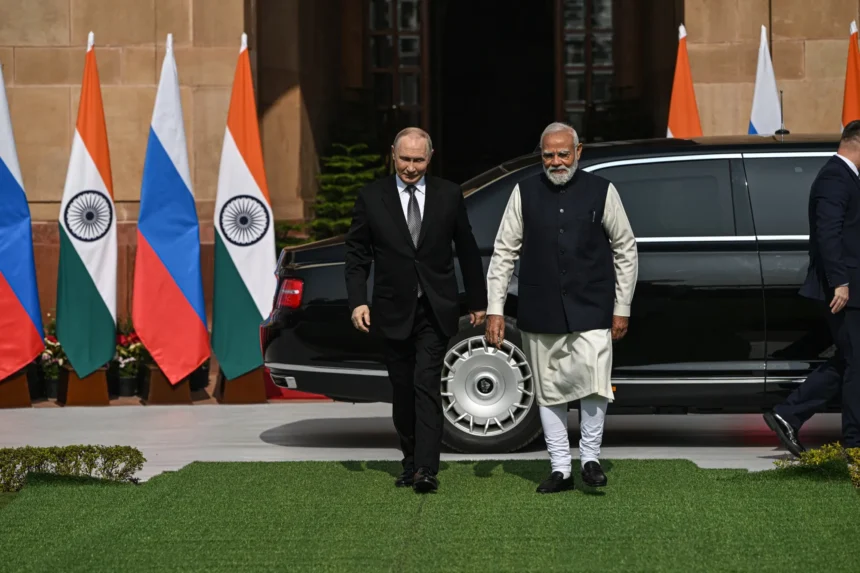
Indian Prime Minister Narendra Modi and Russian President Vladimir Putin held wide-ranging talks aimed at deepening economic cooperation, underscoring New Delhi’s intent to maintain a strategic partnership with Moscow despite growing pressure from the United States and its allies. The meeting highlights India’s delicate balancing act as it seeks to secure energy supplies, expand trade, and diversify geopolitical relationships while navigating an increasingly polarized global environment.
- India’s Strategic Autonomy on Display
- Russia Looks to India to Offset Western Isolation
- Trade Between India and Russia Is Surging
- Defense Cooperation Remains a Cornerstone
- Energy Ties Are Deepening Beyond Oil
- The U.S. Pressure Campaign: India Holds Its Line
- Geopolitical Implications: A Shifting Balance in Eurasia
- Areas of Concern and Challenges Ahead
- Conclusion: A Strategic Bond Strengthened by Necessity and Opportunity
The discussions—covering defense, energy, technology, manufacturing, and regional security—signal that the two nations are committed to expanding bilateral ties even as Russia’s international isolation intensifies and global powers attempt to shape India’s diplomatic direction. For Modi, the engagement reinforces India’s long-standing policy of strategic autonomy. For Putin, it represents a crucial relationship at a time when Russia looks eastward to offset Western sanctions.
India’s Strategic Autonomy on Display
India’s refusal to join Western sanctions against Russia and its ongoing commercial engagement has been one of the most consequential geopolitical dynamics of the past two years. Modi’s meeting with Putin reflects continuity, not a shift, in India’s foreign-policy doctrine.
Key motivations for India’s approach:
- Energy Security: Russia has become one of India’s most important oil suppliers at discounted rates, helping cushion inflation.
- Defense Collaboration: India relies on Russia for a significant portion of its military equipment, maintenance, and critical technologies.
- Multipolar Diplomacy: India prioritizes balancing relations with major powers rather than aligning fully with any single bloc.
- Economic Opportunity: As Russia pivots toward Asian partners, India sees openings in energy, manufacturing, agriculture, and technology partnerships.
Modi’s government argues that its choices are guided by national interest—not global pressure.
Russia Looks to India to Offset Western Isolation
For Putin, expanding ties with India serves several strategic goals:
- Diversifying energy buyers as Europe phases out Russian supplies
- Strengthening geopolitical alliances in Asia
- Attracting investment into Russia’s energy, metals, and industrial sectors
- Securing long-term markets for oil, LNG, fertilizers, and defense equipment
India is one of the few major economies maintaining significant import volumes from Russia, making it an indispensable partner in Moscow’s eastward strategy.
Trade Between India and Russia Is Surging
Bilateral trade has grown dramatically, driven primarily by India’s crude oil purchases.
Highlights:
- Trade volume surpassed $65 billion last year, a record high.
- India is now one of Russia’s top customers for oil and petroleum products.
- Talks are advancing on long-term LNG supply agreements.
- India has become a major market for Russian fertilizers and metals.
However, the trade balance heavily favors Russia, an issue India is seeking to address by boosting its own exports.
Defense Cooperation Remains a Cornerstone
Despite India’s efforts to diversify defense partnerships with the U.S., France, and Israel, Russia remains a critical supplier.
Key ongoing collaborations include:
- Joint development of military platforms
- Maintenance and modernization of legacy systems
- Collaboration on missiles, submarines, and aircraft components
- Cooperation in space technologies
India’s goal is to gradually increase domestic manufacturing under its “Make in India” initiative, with Russia positioned as a co-development partner.
Energy Ties Are Deepening Beyond Oil
The meeting also highlighted cooperation in:
1. LNG and Gas Infrastructure
India is negotiating long-term LNG supply contracts and exploring opportunities in Arctic energy projects.
2. Nuclear Power
Work continues on reactors at the Kudankulam Nuclear Power Plant in Tamil Nadu, with potential expansion on the agenda.
3. Green Energy Transition
Russia is offering technology partnerships for hydrogen, rare metals, and battery materials—sectors India considers strategic for future manufacturing.
The U.S. Pressure Campaign: India Holds Its Line
Washington has repeatedly urged India to scale back its ties with Russia, especially energy imports. Yet New Delhi has remained firm, insisting its decisions are based on national security and economic stability.
Why India resists U.S. pressure:
- Western partners are unable to match Russia’s discounted oil supply.
- Abruptly cutting ties could jeopardize India’s defense capabilities.
- India values its independent geopolitical role.
- U.S.–India relations are strong enough to absorb differences over Russia.
India’s stance is shaping a new model of major-power diplomacy—cooperative but nonaligned.
Geopolitical Implications: A Shifting Balance in Eurasia
The Modi–Putin meeting reverberates across multiple geopolitical theaters:
For the U.S. and Europe:
India’s deepening ties with Russia complicate Western attempts to isolate Moscow and influence global energy markets.
For China:
Russia’s partnership with India balances Beijing’s influence over Moscow, preventing over-dependence.
For the Global South:
India positions itself as a leader capable of engaging all major powers without polarization.
For Russia:
India offers economic breathing room amid sanctions and a pathway to reconfigure trade routes across Asia.
Areas of Concern and Challenges Ahead
Despite the optimistic tone, several issues remain unresolved:
- Trade imbalance heavily favors Russia
- Payment mechanisms remain complicated due to sanctions
- Logistical challenges persist in oil transport and currency settlement
- India’s diversification of defense suppliers could reduce Russia’s dominance over time
- Geopolitical volatility remains a constant risk
Managing these complexities will define the next phase of the partnership.
Conclusion: A Strategic Bond Strengthened by Necessity and Opportunity
The Modi–Putin meeting underscores a partnership shaped by both long-standing ties and evolving geopolitical realities. India sees Russia as a vital energy and defense partner; Russia sees India as an essential economic and geopolitical ally in an increasingly multipolar world.
Despite U.S. pressure and global scrutiny, the relationship is strengthening—not weakening—driven by shared strategic interests and the pursuit of economic stability.
In a world of shifting alliances, India and Russia are signaling that their partnership remains resilient, pragmatic, and central to their respective global strategies.