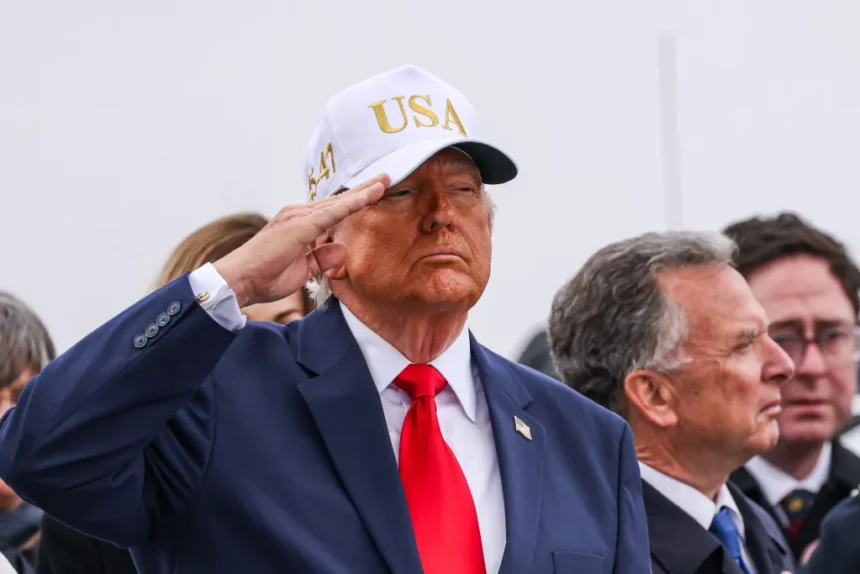
The recent military intervention in Iran, despite initial market resilience, has introduced a complex layer of uncertainty for investors, challenging conventional wisdom that has previously paid dividends in similar geopolitical flare-ups. While oil prices have already climbed past $100 a barrel following the election of Mojtaba Khamenei, the son of the former Supreme Leader, and the White House’s disapproving rhetoric, some on Wall Street are still operating under the assumption of a swift de-escalation. This perspective relies on what has been dubbed the “TACO” trade, an acronym for “Trump Always Chickens Out,” a notion born from the President’s past reversals on aggressive foreign policy stances, particularly regarding tariffs.
This “buy-the-dip” mentality, where investors acquire assets during geopolitical panic anticipating a rapid rebound, has seen success in previous instances. However, Jacob Manoukian, U.S. Head of Investment Strategy for J.P. Morgan Private Bank and Wealth Management, suggests that applying this strategy to the current situation in Iran carries significantly more risk than previous examples. Manoukian articulated his concern prior to the weekend’s leadership change in Iran, highlighting that the conflict’s potential trajectories are numerous and extend beyond the control of any single actor. The core worry among strategists, he explained, is that global events have been set in motion without a clear understanding of their ultimate direction or how they can be effectively managed.
Despite these heightened risks, J.P. Morgan’s base case still anticipates a resolution to the Iran conflict within a matter of weeks. The bank’s estimation projects a deal being reached within two to three weeks, partly driven by the President’s likely reluctance to see oil prices surge further during a midterm election year. Additionally, the finite nature of munitions for both Iran and the Gulf States suggests a natural limitation to the conflict’s duration. However, Manoukian underscored that this remains an estimation, not a certainty, and prudent investors should not treat it as a given. The unpredictability of the situation demands a more cautious approach than a speculative “TACO” trade.
Instead of chasing short-term gains, Manoukian advocates for ensuring clients maintain balanced portfolios, particularly by exploring under-utilized asset classes. He points to infrastructure assets as a prime example, noting that J.P. Morgan Private Bank’s 2026 Global Family Office Report revealed 80% of respondents lacked exposure to this sector. In a world increasingly focused on resilience, supply chain security, and autonomy in natural resources and energy, such assets could prove invaluable. They offer a structural and strategic advantage, potentially enhancing a portfolio during “risk-off” moments in markets, precisely the kind of environment the Iran conflict could foster.
The perceived esoteric nature of infrastructure assets often leads to investor aversion, making them harder to access and understand. However, Manoukian observes a growing acceptance of evergreen structures within the alternative investment space, which has made clients more willing to engage with these asset classes. This shift is partly due to the improved liquidity offered by these structures and a growing recognition of infrastructure’s importance in a diversified portfolio. As geopolitical tensions continue to introduce volatility, the strategic inclusion of such assets could offer a more stable path forward than speculative bets on rapid de-escalation. The current climate necessitates a re-evaluation of risk and a longer-term perspective on investment strategy, moving beyond the hope for quick resolutions.