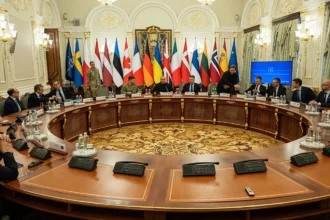
The unexpected military operation by the United States that led to the capture of Nicolás Maduro and his wife, Cilia Flores, in Venezuela on Saturday has ignited a significant debate within the United Nations Security Council. Nations convened on Monday to address the implications of Washington’s actions, with many members expressing strong objections to President Donald Trump’s intervention in Caracas. This sentiment was further amplified by the President’s recent remarks suggesting potential military expansion into other South American countries, including Mexico and Colombia, citing drug-trafficking allegations.
During the emergency session, the council heard a range of criticisms regarding the US operation. Danish Ambassador to the UN, Christina Markus Lassen, articulated her country’s position, stating unequivocally that “the inviolability of borders is not up for negotiation.” While her comments did not directly name the United States, they came in the context of the Venezuelan incident and Trump’s renewed interest in acquiring Greenland, a Danish territory. Lassen also stressed that “no state should seek to influence political outcomes in Venezuela through the use of threat of force or through other means inconsistent with international law.” This echoed a broader concern among member states that the principles of international law were being undermined.
France, a permanent member of the Security Council, also voiced its disapproval. Deputy French Ambassador to the UN, Jay Dharmadhikari, highlighted the potential erosion of the global order when permanent members of the council violate international law. Dharmadhikari explicitly stated that the military action leading to Maduro’s capture ran counter to both the principle of peaceful dispute resolution and the non-use of force. This stance from France, despite earlier reports of French President Emmanuel Macron’s generally positive reaction to Maduro’s capture, underscored the gravity with which the international community viewed the precedent set by the US operation.
US envoy Mike Waltz, President Trump’s former national security adviser, defended the action as a “surgical law enforcement operation.” Waltz challenged the council’s criticism, questioning the legitimacy it might confer upon an individual he described as a “narco-terrorist” and dictator in the Western Hemisphere. He argued that Maduro was not considered a legitimate, democratically elected president across Europe and North America, citing irregularities in Venezuela’s 2024 presidential election, which many nations and the European Union viewed as rigged. This position highlighted a fundamental divergence in how the US and many other nations perceive the Venezuelan government.
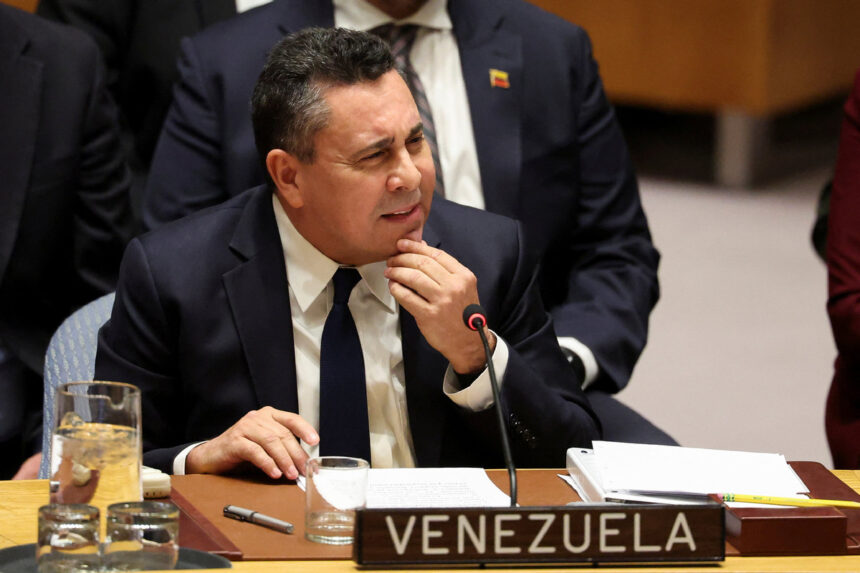
The broader implications of the US action were not lost on UN Secretary-General Antonio Guterres, who expressed his deep concern over the apparent disregard for international law in the January 3rd military action. Guterres warned that Washington’s “grave” actions could establish a dangerous precedent for future international relations. Venezuela’s Ambassador to the UN, Samuel Moncada, urged the Security Council to move beyond veiled criticisms and demand the release of Maduro and his wife. Moncada cautioned that tolerating or downplaying such actions, including the “kidnapping of a head of state” and the “bombing of a sovereign country,” would send a devastating message: that law is optional and force is the true arbiter of international relations. He warned that accepting this logic would lead to a deeply unstable world.
China and Russia, both permanent members of the Security Council and historical allies of Venezuela, called for a united front against what they characterized as a US return to an “era of lawlessness.” Maduro, much like his predecessor, had fostered close ties with Moscow, while Beijing served as a primary destination for Venezuelan oil exports. The capture of Maduro and Flores, seized from their home on a military base in Caracas and transported aboard a US warship for prosecution in New York on narco-terrorism conspiracy charges, marked a dramatic escalation in the long-standing tensions between Washington and Caracas. Both individuals pleaded not guilty in a Manhattan courthouse, asserting their unlawful capture.