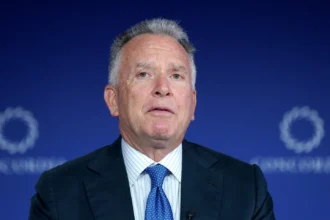
Federal Reserve Governor Christopher Waller recently indicated that the robust job gains reported for January might allow the central bank to postpone a rate cut at its upcoming March meeting. This stance comes amidst ongoing scrutiny of the economic landscape, particularly the labor market’s true health. Waller, a figure whose pronouncements often carry significant weight in financial circles, suggested that the reported addition of 130,000 jobs in January could be an isolated event, necessitating further data before drawing firm conclusions.
His current position represents a notable shift from just a month prior, when he was one of two governors to dissent against the Fed’s decision to maintain its key interest rate. That earlier decision followed three rate reductions late last year, leaving the short-term rate at approximately 3.6%. A reduction in this rate typically translates over time to lower borrowing costs across various sectors, including mortgages, auto loans, and business financing, although broader financial markets also play a role in setting these rates.
Waller conveyed that a similarly positive jobs report next month would be crucial for him to conclude that the labor market is genuinely improving, especially considering what he characterized as a “very weak” performance in 2023. He even speculated that the modest job gains initially reported for last year might eventually be revised downward, potentially even below zero. This scenario, he admitted, presents a perplexing contradiction: an economy currently exhibiting solid growth alongside minimal, or even negative, job creation. “This would be the first time in my career, my life, that I saw an economy growing like this, and zero job growth,” Waller stated, acknowledging the unusual nature of such a divergence. He expressed uncertainty about how to interpret this phenomenon, though he did offer that increased hiring later in the year could resolve the apparent inconsistency.
Another potential factor contributing to this conundrum, Waller suggested, might be enhanced productivity. The pandemic, in his view, compelled companies to find ways to produce more with fewer employees, a trend that could account for economic expansion without a corresponding surge in employment figures. This perspective, if accurate, could reshape how economists and policymakers understand the relationship between growth and job creation in the current environment.
The Fed Governor also weighed in on the Supreme Court’s recent decision regarding many of former President Donald Trump’s tariffs. Waller believes this ruling would likely have only a limited effect on the broader economy and inflation, thus not influencing his current view on interest rates. While he conceded the decision could offer a “positive impact on spending and investment,” he qualified this by noting the uncertainty surrounding its potential magnitude and duration. Furthermore, he pointed out that the White House is reportedly exploring alternative legal avenues to reinstate these tariffs, introducing “considerable uncertainty over to what extent tariffs will continue.”
Looking ahead, Waller framed the upcoming jobs report as a critical determinant for the Fed’s next move. If February’s data mirrors January’s strength, he indicated it might be appropriate to maintain the current short-term rate, allowing for continued observation of inflation and labor market health. Conversely, he stated, “if the good labor market news of January is revised away or evaporates in February, a cut should be made at the March meeting.” For now, he views these two potential outcomes as “close to a coin flip,” underscoring the tightrope the central bank walks as it navigates economic data. This cautious approach contrasts with the recent criticisms from figures like Donald Trump, who publicly urged “LOWER INTEREST RATES” and directed sharp comments at Chair Jerome Powell following a report indicating slower economic growth in the final quarter of last year.