
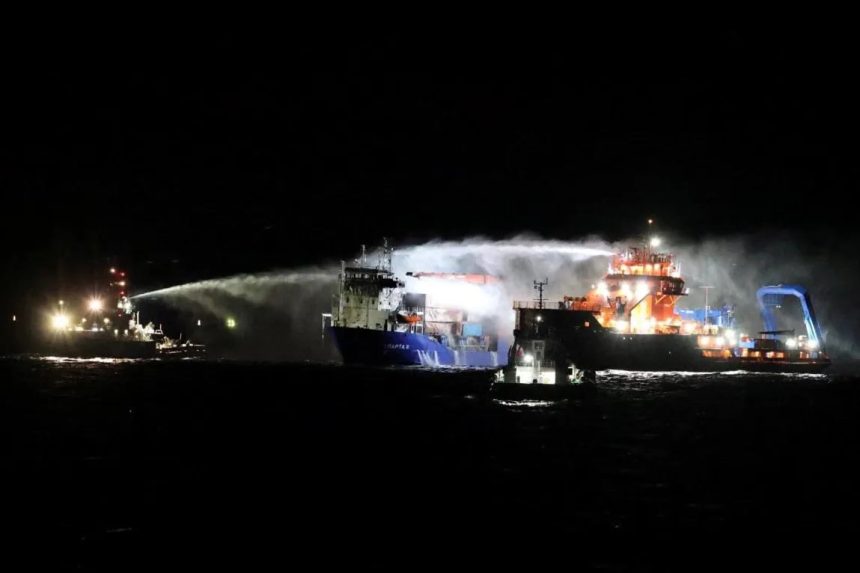
President Volodymyr Zelenskyy confirmed on Monday that Ukraine was responsible for a drone strike on a Russian cargo ship in the Gulf of Finland, expanding a campaign of attacks against Moscow’s maritime supply lines far beyond the Black Sea. The vessel, Sparta II, was hit on Saturday. Zelenskyy said it was carrying weapons and was therefore a legitimate military target.
The strike marks one of the most northerly operations Ukraine has acknowledged in its war against Russia’s full-scale invasion. It also signals a shift in tactics, with Kyiv increasingly willing to strike Russian commercial and military shipping in European waters to disrupt logistics and raise the cost of the war for the Kremlin.
A widening campaign
Ukraine has spent much of the war targeting Russian naval assets in and around the Black Sea. The destruction of the Moskva cruiser early in the conflict and repeated drone boat attacks on the Black Sea Fleet forced Russia to relocate some vessels and weakened its blockade of Ukrainian grain ports. More recently, Kyiv has broadened its scope.
Just days before the Gulf of Finland strike, Ukraine confirmed an attack on a Russian ship off the coast of Libya. The operations suggest a coordinated effort to track and target vessels carrying military cargo, spare parts or fuel to Russian forces wherever they travel. For a country with no large navy of its own, Ukraine has become remarkably effective at sea denial.
Allies and escalation
Zelenskyy acknowledged that the attack in Finnish waters might unsettle some allies. Striking targets outside the immediate war zone carries diplomatic risks, especially when the operation occurs near NATO territory and involves civilian shipping lanes. Finland, which joined NATO in 2023, has led investigations into the incident and released photographs of rescue operations around the damaged ship.
The Ukrainian president’s admission appears designed both to claim credit for the operation and to manage the political fallout by framing it as a lawful strike on a military supply vessel. Under the laws of armed conflict, a ship carrying weapons can be targeted, even if it sails under a civilian flag. The difficulty is proving the cargo and showing that the attack was proportionate.
Russia's maritime vulnerability
Russia's merchant fleet has come under growing scrutiny since the invasion of Ukraine. A shadow fleet of older, often uninsured tankers and cargo ships has kept Russian energy and goods moving despite Western sanctions. But that fleet is difficult to defend and increasingly exposed to asymmetric attacks by drones, saboteurs and special forces.
The Sparta II strike demonstrates that Ukraine can reach these vessels even in the Baltic approaches, far from the active front line. It also highlights the limits of Russian maritime security, which is stretched between protecting military supply routes, energy exports and strategic bases.
Implications for the war
The attack is unlikely to alter the course of the ground war on its own. But it adds to the pressure on Russia's logistics network at a time when Moscow is trying to sustain offensive operations in eastern Ukraine while managing a slowing economy and international isolation. Each successful strike forces Russia to divert resources to protection and reroute shipping, raising costs and complicating planning.
For Kyiv, the operation is also a message to Moscow and to Western backers. It shows that Ukraine can still take the initiative more than four years after the invasion, and that it is prepared to operate far from home waters despite having no conventional naval power. As winter approaches and both sides prepare for another season of attritional fighting, that message matters.